IP65 vs IP67 Rugged Tablet: What’s the Difference?
IP65 and IP67 are two of the most common protection ratings found on rugged tablets, but they are designed for different levels of environmental exposure.
Understanding the difference can help businesses avoid paying for unnecessary protection—or selecting a device that is not adequately protected for the real working environment.
IP65
IP67
IEC 60529
Part 1: IP65 vs IP67 Rugged Tablet: Why the Rating Matters
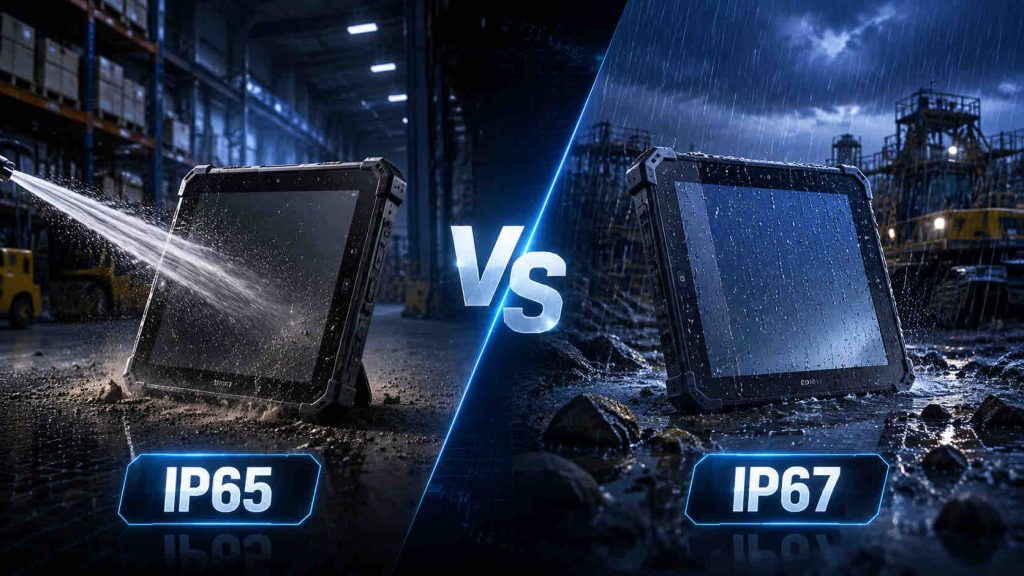
When comparing an IP65 vs IP67 rugged tablet, the most important difference is the level of protection provided against water exposure.
Both ratings indicate a high level of protection against dust, which is important in warehouses, factories, construction sites, logistics operations and outdoor industrial environments. However, the water-protection requirements represented by the second digit are different.
An IP65 rugged tablet is commonly selected for industrial environments where the device may encounter dust, splashes or water jets during normal operation.
An IP67 rugged tablet is designed for applications requiring a higher level of protection against temporary water immersion under specified test conditions.
However, a higher IP rating does not automatically mean that a tablet is the better choice for every project.
The correct protection level depends on the actual operating environment, the type of water exposure, the required interfaces, the device design and the total project cost.
This guide explains what IP65 and IP67 mean, how the ratings differ, where each type of rugged tablet is commonly used and what businesses should evaluate before selecting a device.
IP ratings are defined under IEC 60529, the international standard covering degrees of protection provided by electrical equipment enclosures.
Quick Answer
IP65 and IP67 rugged tablets both provide strong protection against dust, but they differ in water protection.
IP65 is designed for protection against water jets under specified test conditions, while IP67 addresses temporary immersion under specified conditions.
For many warehouses, factories and logistics operations, IP65 may be sufficient. IP67 becomes more relevant when the tablet may face greater water exposure or temporary immersion.
Always choose the IP rating according to the real working environment rather than simply selecting the highest number.
Part 2: What Does an IP Rating Actually Mean?
Before comparing an IP65 vs IP67 rugged tablet, it is important to understand how an IP rating is structured.
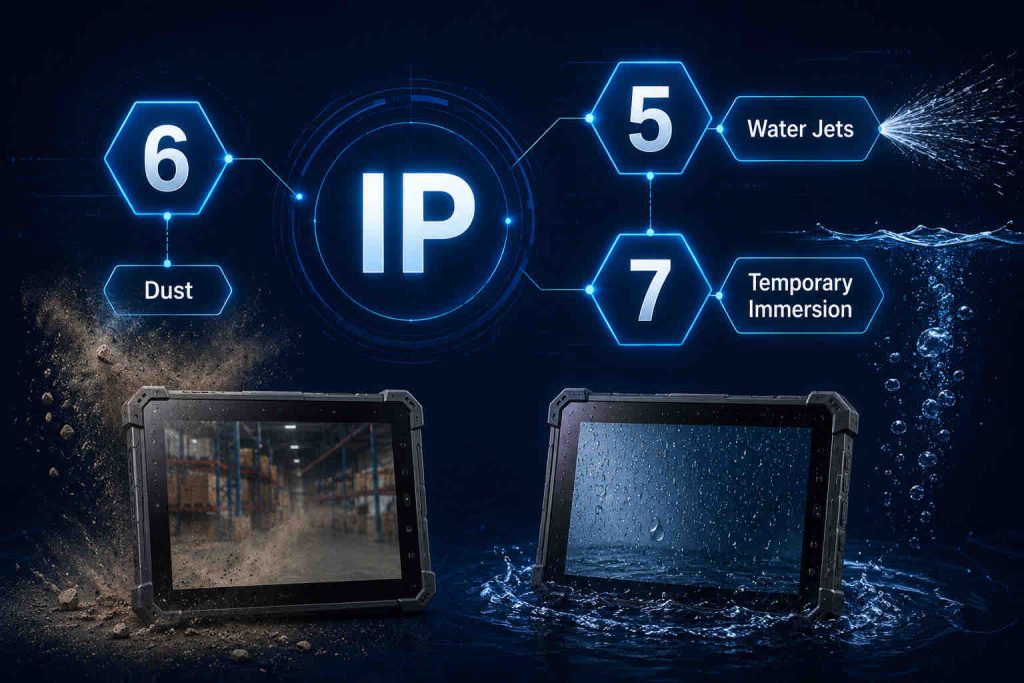
The letters “IP” stand for Ingress Protection. The rating uses two digits to describe how well an enclosure protects internal components against solid objects and liquids under defined test conditions.
The first digit relates to protection against solid particles such as dust, while the second digit relates to protection against water.
This means that IP65 and IP67 share the same level of dust protection but differ in the type of water exposure they are designed to withstand.
1. What Does the First Digit Mean?
The first digit in an IP rating indicates the level of protection against solid foreign objects.
For both IP65 and IP67, the first digit is “6”.
A first digit of 6 represents the highest level of solid-particle protection in the IP classification system. In practical terms, the enclosure is designed to prevent dust from entering in quantities that would interfere with normal operation.
For rugged tablets used in warehouses, factories, construction sites, mining operations or outdoor industrial environments, this is important because dust can enter ports, speakers, connectors and internal electronic components if the enclosure is not properly sealed.
Because both IP65 and IP67 begin with the number 6, they provide the same dust-protection classification.
First Digit: 6
Dust Protection: Highest solid-particle protection level in the IP rating system.
2. What Does the Second Digit Mean?
The second digit indicates the level of protection against water.
This is where IP65 and IP67 differ.
In IP65, the second digit is “5”, which represents protection against water jets under defined test conditions.
In IP67, the second digit is “7”, which represents protection against temporary immersion in water under specified conditions.
This does not mean that an IP67 tablet is permanently waterproof or suitable for unlimited underwater use. The rating applies only to the specific test conditions defined by the standard and the device configuration used during testing.
IP65
Dust-tight protection
Water protection:
Water jets under defined test conditions
Typical environments:
Warehouses
Factories
Loading docks
Field service
IP67
Dust-tight protection
Water protection:
Temporary immersion under specified conditions
Typical environments:
Outdoor work
Utilities
Mining
Wet industrial environments
3. Why IP65 and IP67 Are Not Simply “Good vs Better”
It is easy to assume that IP67 is automatically better than IP65 because the number is higher.
However, industrial device selection should be based on the real working environment rather than choosing the highest rating available.
An IP65 rugged tablet may be completely appropriate for a warehouse, factory or logistics center where the device is exposed mainly to dust, splashes or cleaning water.
An IP67 rugged tablet becomes more relevant when there is a realistic risk of temporary immersion or greater water exposure.
Choosing a higher rating than the application requires can increase cost, affect port design and reduce flexibility without creating a meaningful operational advantage.
The correct decision is therefore not “Which number is higher?” but “Which type of protection matches the real risk?”
IP65 vs IP67 Rugged Tablet Quick Comparison
| Comparison | IP65 Rugged Tablet | IP67 Rugged Tablet |
|---|---|---|
| Dust Protection | Dust-tight | Dust-tight |
| First Digit | 6 | 6 |
| Water Protection | Water jets under defined test conditions | Temporary immersion under specified conditions |
| Second Digit | 5 | 7 |
| Typical Use | Warehouses, factories, logistics, field service | Outdoor work, utilities, mining, wetter environments |
| Best Choice When | Dust and spray exposure are the main concerns | Temporary immersion or higher water exposure is a realistic risk |
| Automatically Better? | No — depends on application | No — depends on application |
Quick Takeaway
IP65 and IP67 rugged tablets have the same dust-protection classification because both use “6” as the first digit.
The key difference is water protection.
IP65 addresses water jets under defined test conditions.
IP67 addresses temporary water immersion under specified conditions.
Choose the rating based on the actual working environment, not simply the higher number.
Part 3: IP65 Rugged Tablet: When Is It the Right Choice?
An IP65 rugged tablet is a practical choice for many industrial environments where dust and water spray are the primary environmental risks.
Because the first digit is 6, the enclosure provides the highest dust-protection classification in the IP rating system. The second digit 5 indicates protection against water jets under defined test conditions.
For many warehouses, factories, logistics centers and field-service applications, this level of protection is sufficient without requiring the additional immersion protection associated with IP67.
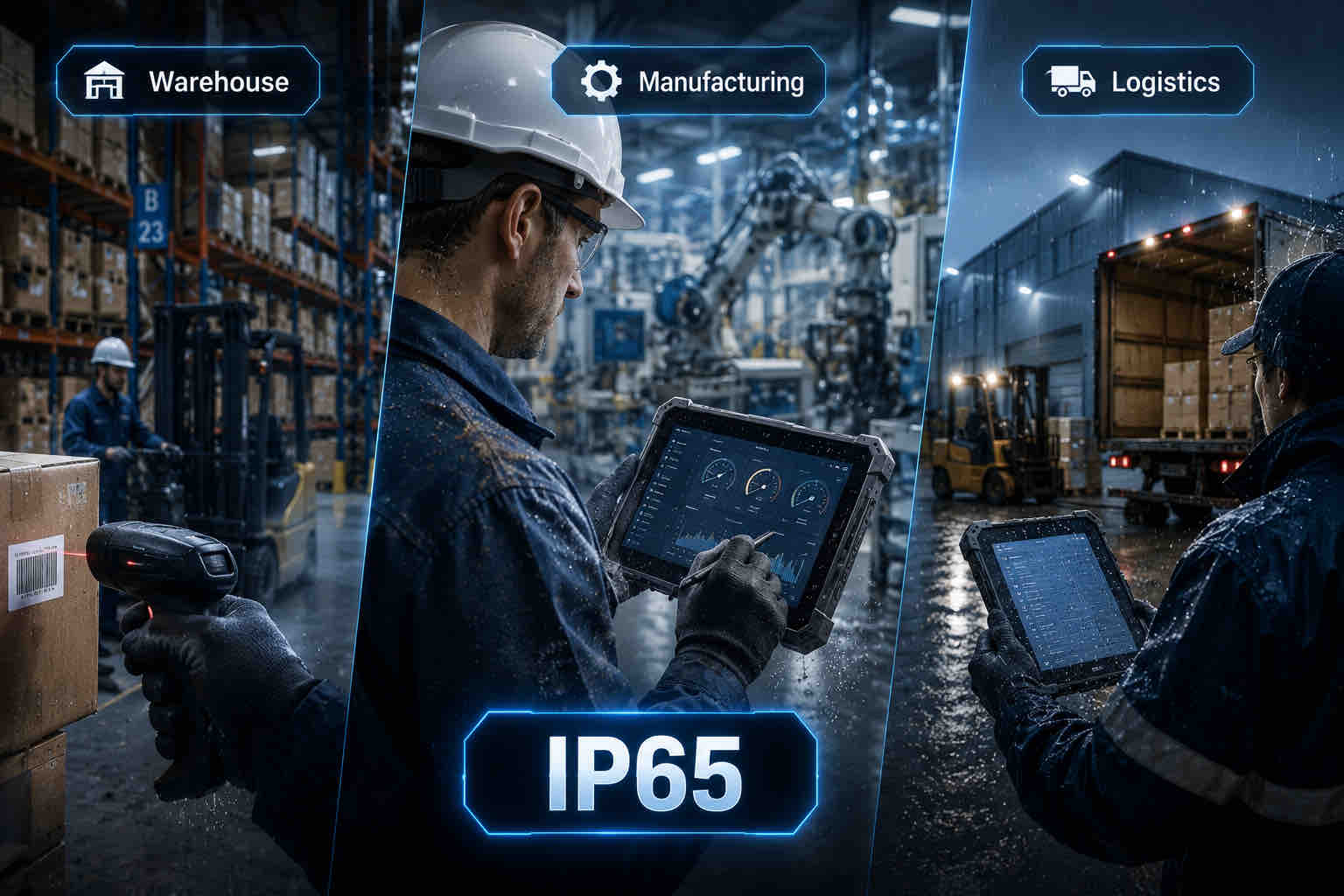
1. Warehouses and Distribution Centers
Warehouses expose tablets to dust, packaging debris, accidental splashes and frequent handling.
Employees may use rugged tablets for inventory management, barcode scanning, order picking, receiving, shipping and asset tracking throughout long work shifts.
In these environments, an IP65 rugged tablet can provide strong protection against dust while helping the device withstand common exposure to water spray or cleaning processes.
For most indoor warehouse applications, temporary water immersion is not a normal operating risk, so IP65 may provide sufficient environmental protection.
2. Manufacturing and Production Facilities
Manufacturing environments may expose tablets to dust, vibration, metal particles, oils, cleaning procedures and continuous handling.
Rugged tablets are commonly used for production monitoring, quality inspection, maintenance records, material tracking and equipment management.
An IP65-rated tablet can be suitable when the main environmental risks are dust and water spray rather than full immersion.
For production lines or maintenance areas, businesses should also evaluate vibration resistance, operating temperature and industrial interfaces in addition to the IP rating.
3. Logistics and Loading Dock Operations
Logistics workers often move between warehouses, loading docks, vehicles and outdoor transition areas.
Tablets may encounter dust, light rain, splashes and rapidly changing working conditions.
An IP65 rugged tablet can be a strong choice when the device is not expected to be submerged but still requires reliable protection against dust and water exposure.
Combined with 4G/5G, GPS and vehicle docking, IP65 rugged tablets can support route management, proof of delivery, shipment tracking and fleet operations.
4. Field Service and Maintenance
Field-service technicians may work around equipment, construction sites, customer facilities and outdoor locations.
Their tablets are often used to access work orders, record service notes, capture inspection photos and communicate with remote teams.
IP65 can be sufficient when technicians face dust, splashes and occasional rain but are unlikely to expose the device to temporary immersion.
For outdoor field service, screen brightness, glove-touch support, battery life and cellular connectivity should also be considered.
Best Use Cases for IP65 Rugged Tablets
✓ Indoor warehouses
✓ Distribution centers
✓ Manufacturing plants
✓ Loading docks
✓ Logistics operations
✓ Field service
✓ Equipment maintenance
✓ Vehicle-mounted industrial use
✓ Environments with dust and water spray
When IP65 May Not Be Enough
IP65 may not be the best choice when:
• The device may fall into water
• Temporary immersion is a realistic risk
• The work environment involves frequent heavy rain or flooding
• The application requires a higher level of liquid ingress protection
In these cases, an IP67 rugged tablet may be more appropriate.
Typical IP65 Industrial Applications
| Application | Typical Environmental Risk | Why IP65 Can Work |
|---|---|---|
| Warehouse | Dust, debris, occasional water spray | Strong dust protection and water-jet resistance |
| Manufacturing | Dust, cleaning processes, machine environments | Suitable for many controlled industrial conditions |
| Logistics | Loading docks, light rain, changing environments | Good protection without requiring immersion resistance |
| Field Service | Dust, splashes, occasional rain | Suitable when immersion risk is low |
Quick Recommendation
Choose an IP65 rugged tablet when dust and water spray are the main environmental risks and temporary immersion is unlikely.
For many warehouses, factories, logistics operations and field-service applications, IP65 provides a practical balance between protection, flexibility and cost.
If temporary immersion is a realistic possibility, consider IP67 instead.
For many controlled industrial environments, the IP65 vs IP67 rugged tablet decision ultimately depends on whether temporary immersion is a realistic operational risk.
Part 4: IP67 Rugged Tablet: When Do You Really Need It?
An IP67 rugged tablet is designed for industrial applications where the risk of water exposure is greater than in a typical indoor warehouse or factory environment.
Like IP65, IP67 uses “6” as the first digit, meaning the enclosure provides the highest level of protection against solid particles in the IP classification system.
The key difference is the second digit. A rating of “7” indicates protection against temporary immersion in water under specified test conditions.
For outdoor work, utilities, mining, transportation and other wet industrial environments, this additional level of water protection may provide a more suitable solution.
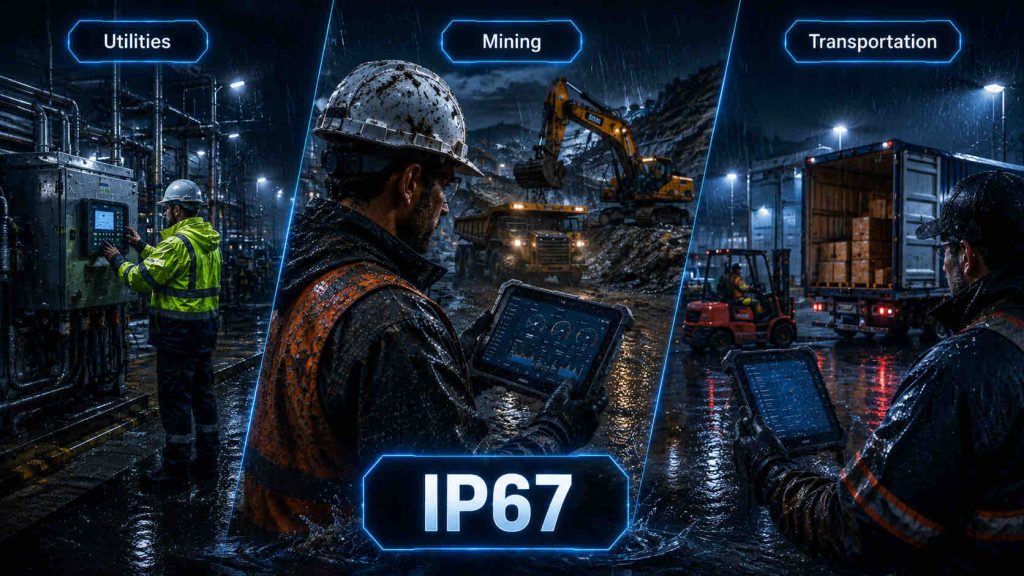
1. Outdoor Field Operations
Outdoor workers may face rain, puddles, wet equipment, mud and rapidly changing weather conditions.
Field technicians, inspectors, utility workers and maintenance teams often use rugged tablets for work orders, GPS navigation, inspection reports, photo documentation and real-time communication.
When the device may be exposed to heavier rain or accidentally dropped into shallow water, an IP67 rugged tablet can provide additional protection compared with IP65.
For outdoor deployment, businesses should also evaluate screen brightness, wet-touch support, battery life and operating temperature.
2. Utilities and Infrastructure
Utility and infrastructure projects often operate in environments where moisture exposure is difficult to control.
Workers may inspect water systems, electrical infrastructure, pipelines, communications equipment or outdoor facilities during wet weather.
In these conditions, a rugged tablet may be exposed to rain, wet gloves, standing water or temporary accidental immersion.
IP67 can therefore be useful when the application requires a higher level of protection against liquid ingress than standard industrial splash resistance.
3. Mining and Heavy Industrial Environments
Mining and heavy-industry applications can expose mobile devices to dust, mud, rain, vibration and harsh outdoor conditions.
Rugged tablets may be used for equipment inspection, vehicle tracking, maintenance management, production monitoring and field data collection.
The dust-tight protection provided by the first digit “6” is especially valuable in these environments, while the second digit “7” adds protection against temporary immersion under specified conditions.
For mining projects, businesses should evaluate IP rating together with vibration resistance, drop protection, operating temperature and vehicle-mounting requirements.
4. Transportation and Wet Loading Areas
Transportation and logistics operations may involve loading docks, ports, vehicle yards and outdoor transfer areas that are regularly exposed to rain.
Drivers and logistics staff may carry rugged tablets between vehicles, warehouses and outdoor locations throughout the day.
If tablets are likely to encounter significant water exposure or accidental temporary immersion, IP67 may provide a better safety margin than IP65.
However, if the device is mainly used inside vehicles or covered loading areas, IP65 may still be sufficient.
5. When IP67 May Be More Than You Need
A higher IP rating should not automatically be treated as a purchasing requirement.
For indoor warehouses, factories, offices and vehicle-mounted applications where temporary immersion is highly unlikely, IP65 may already provide sufficient environmental protection.
IP67 designs may require additional sealing, port covers or structural changes that can affect convenience, accessory design or cost.
Businesses should therefore evaluate the probability of actual immersion instead of choosing IP67 simply because the second digit is higher.
Best Use Cases for IP67 Rugged Tablets
✓ Outdoor field service
✓ Utilities and infrastructure
✓ Mining operations
✓ Wet industrial environments
✓ Transportation yards
✓ Ports and outdoor loading areas
✓ Applications with a realistic risk of temporary immersion
✓ Environments with heavy rain or frequent water exposure
Consider IP65 Instead When
• The tablet is used mainly indoors
• Dust is the primary environmental risk
• Water exposure is limited to splashes or cleaning spray
• Temporary immersion is extremely unlikely
• Easier port access or lower project cost is more important
Typical IP67 Industrial Applications
| Application | Typical Environmental Risk | Why IP67 Can Help |
|---|---|---|
| Outdoor Field Work | Heavy rain, puddles, wet equipment | Provides additional protection against temporary immersion |
| Utilities | Wet infrastructure, rain, standing water | Suitable for higher liquid-exposure environments |
| Mining | Dust, mud, rain, harsh outdoor conditions | Combines dust-tight protection with higher water protection |
| Transportation Yards | Outdoor loading, rain, accidental water exposure | Useful when immersion risk is realistic |
Quick Recommendation
Choose an IP67 rugged tablet when temporary water immersion or heavier water exposure is a realistic part of the working environment.
IP67 is particularly useful for outdoor field service, utilities, mining, transportation yards and wet industrial operations.
For controlled indoor environments where dust and water spray are the main risks, IP65 may still provide the more practical solution.
When evaluating an IP65 vs IP67 rugged tablet for outdoor use, buyers should pay particular attention to the actual level of water exposure.
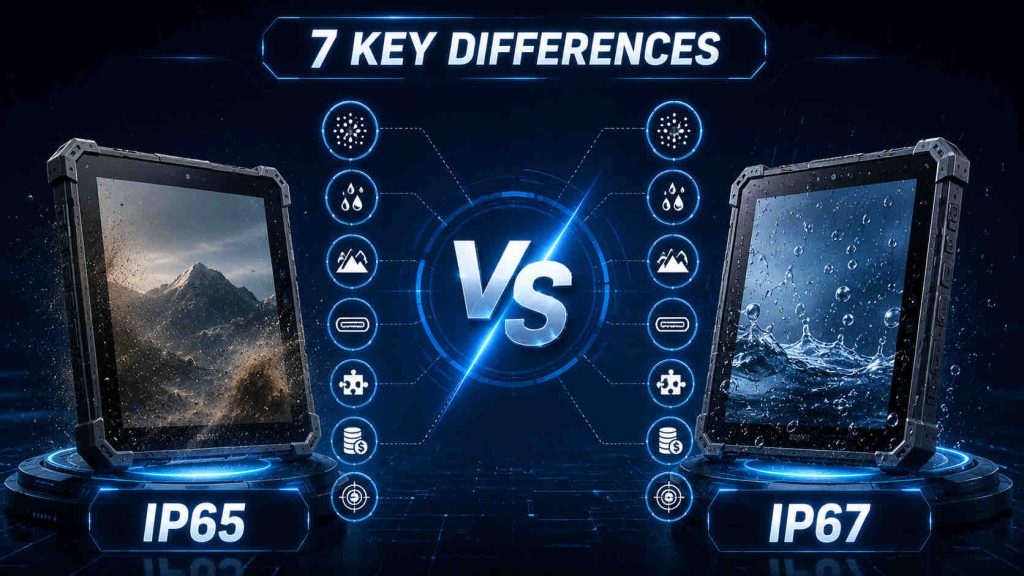
Part 5: IP65 vs IP67 Rugged Tablet: 7 Key Differences
The difference between an IP65 vs IP67 rugged tablet is not limited to one number in the IP rating.
Both devices can provide strong dust protection, but the water-protection level, typical applications, enclosure design, accessory flexibility and project cost can be different.
Understanding these seven key differences helps businesses select the right protection level without paying for features that are unnecessary for the real working environment.
1. Dust Protection
IP65 and IP67 rugged tablets provide the same dust-protection classification because both ratings begin with the number 6.
This means the enclosure is designed to prevent dust ingress under the conditions defined by the IP classification system.
For warehouses, manufacturing plants, construction sites, mining operations and logistics facilities, this level of protection helps reduce the risk of dust entering internal electronic components, ports and connectors.
From a dust-protection perspective, there is no advantage to choosing IP67 over IP65.
2. Water Protection
Water protection is the most important difference between IP65 and IP67.
IP65 is associated with protection against water jets under defined test conditions.
IP67 addresses temporary immersion in water under specified conditions.
This means IP67 may be more suitable for environments where accidental immersion is a realistic risk, while IP65 can be sufficient when the main risks are splashes, cleaning water or rain.
The correct choice depends on the actual type of water exposure rather than simply selecting the higher number.
3. Typical Working Environment
IP65 rugged tablets are commonly suitable for controlled industrial environments such as warehouses, factories, distribution centers and loading docks.
IP67 rugged tablets are more relevant for outdoor field work, utilities, mining, transportation yards and other locations where greater water exposure may occur.
However, the industry alone does not determine the correct rating.
For example, a logistics company may use IP65 tablets inside vehicles and warehouses but require IP67 devices for employees who regularly work outdoors in heavy rain.
4. Port and Connector Design
Higher levels of ingress protection often require additional sealing around ports, connectors and openings.
Depending on the product design, IP67 tablets may use tighter port covers, sealed connectors or fewer exposed interfaces.
This can provide greater protection against liquid ingress but may affect how quickly users access USB, charging, audio or other ports.
For applications that require frequent connection to industrial peripherals, businesses should consider both ingress protection and interface accessibility.
5. Accessories and Docking Options
Accessories can also influence the practical difference between IP65 and IP67 rugged tablets.
Vehicle docks, charging cradles, keyboards and expansion interfaces must be compatible with the tablet enclosure and connector design.
A highly sealed device may require specialized docking or charging solutions to maintain environmental protection.
Before purchasing, confirm that required accessories are available and that docking does not compromise the intended protection level.
6. Product and Project Cost
IP67 rugged tablets may cost more than comparable IP65 devices because stronger sealing, additional testing and different enclosure designs can increase product complexity.
However, purchase price should not be the only consideration.
If the real working environment includes a realistic risk of temporary immersion, the additional protection may prevent equipment failure and reduce downtime.
On the other hand, paying for IP67 protection in a controlled indoor warehouse may not create a meaningful operational benefit.
7. Best Use Case
The best use case is ultimately the most important difference.
Choose IP65 when the device mainly needs protection against dust, splashes, cleaning spray and normal industrial water exposure.
Choose IP67 when the working environment includes a realistic possibility of temporary immersion, heavier rain or greater liquid exposure.
The goal is not to choose the highest rating available. The goal is to select the protection level that matches the real application.
IP65 vs IP67 Rugged Tablet Comparison Table
| Comparison Factor | IP65 Rugged Tablet | IP67 Rugged Tablet |
|---|---|---|
| Dust Protection | Dust-tight | Dust-tight |
| Water Protection | Water jets under defined test conditions | Temporary immersion under specified conditions |
| Typical Environment | Warehouses, factories, logistics centers | Outdoor field work, utilities, mining, wet environments |
| Port Design | May offer easier access depending on design | May require stronger sealing and protected ports |
| Accessories | Broad industrial accessory options | Accessories must maintain required sealing |
| Project Cost | Often lower when immersion protection is unnecessary | May be higher due to stronger sealing and testing |
| Best Use Case | Dust, splashes and water spray | Higher water exposure or temporary immersion risk |
Which One Should You Choose?
Choose IP65 if the tablet will mainly operate in warehouses, factories, vehicles or other industrial environments where dust, splashes and water spray are the primary risks.
Choose IP67 if the tablet will regularly operate outdoors or in wet environments where temporary immersion is a realistic possibility.
If you are unsure, evaluate the actual water-exposure scenario instead of selecting the higher IP rating automatically.
For a complete purchasing framework covering operating system, screen size, connectivity, battery, scanners and accessories, read our guide on how to choose a rugged tablet for industrial use.
Quick Takeaway
IP65 and IP67 rugged tablets provide the same dust-protection classification.
The main difference is the level and type of water protection.
IP67 can provide additional value when temporary immersion is a realistic risk, while IP65 may be the more practical and cost-effective choice for many controlled industrial environments.
Always match the IP rating to the real application.
Part 6: How to Choose Between IP65 and IP67 Rugged Tablets
Choosing between an IP65 and IP67 rugged tablet should be based on the actual environmental risks of the project rather than simply selecting the higher rating.
The most important questions involve water exposure, operating location, interface requirements, accessory compatibility and project cost.
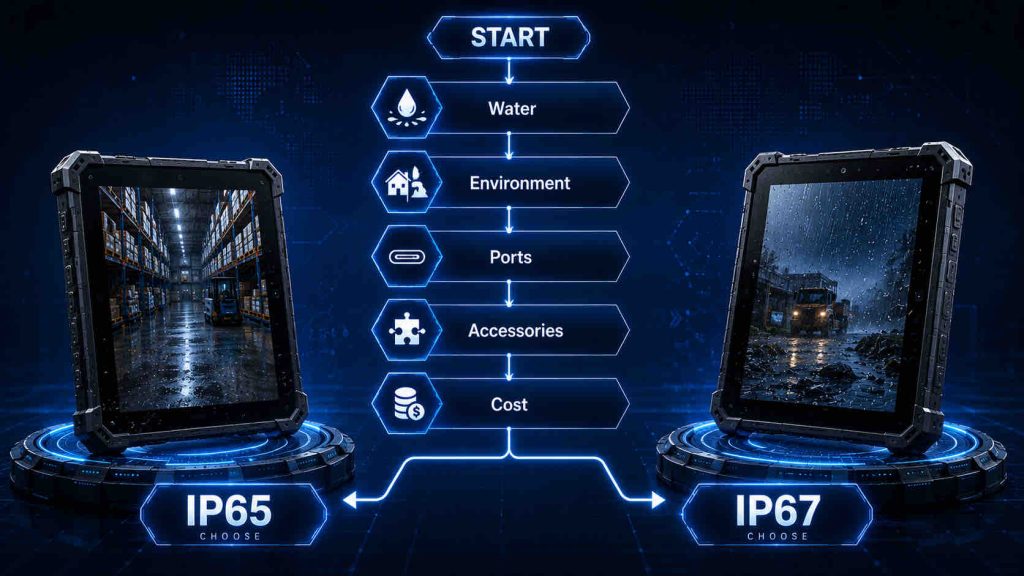
The following five-step process can help businesses determine which protection level is more appropriate for their application.
IP protection is only one part of rugged device durability. For shock, vibration, temperature and environmental testing, see our MIL-STD-810H Rugged Tablet Guide.
1: Evaluate the Real Water Exposure
Start by identifying exactly how the tablet may come into contact with water.
If the device is mainly exposed to splashes, cleaning spray, light rain or water jets, IP65 may be sufficient.
If the working environment includes a realistic possibility of temporary immersion, deeper puddles, heavy rain or accidental drops into water, IP67 may be more appropriate.
The key question is not whether water is present, but what type of water exposure is actually expected.
2: Determine Whether the Tablet Is Mainly Used Indoors or Outdoors
Indoor industrial environments such as warehouses and factories usually have more controlled exposure conditions.
For these applications, IP65 often provides adequate protection against dust and water spray.
Outdoor applications such as utilities, mining, field service and transportation yards may face heavier rain, mud, standing water and unpredictable weather.
In these environments, IP67 can provide additional protection when temporary immersion is a realistic risk.
3: Check How Often Ports and Interfaces Are Used
Some rugged tablets use sealed covers to protect USB, charging, audio or communication ports.
If employees frequently connect external devices, printers, scanners, Ethernet cables or serial equipment, port accessibility becomes an important practical consideration.
A highly sealed design may provide stronger ingress protection but can also require more careful handling of port covers.
Businesses should confirm that the required protection level is compatible with their daily interface usage.
4: Confirm Accessories and Mounting Requirements
Accessories such as vehicle docks, charging cradles, keyboards and expansion modules must work with the tablet enclosure.
For forklift, truck or fixed industrial installations, the device may be protected from direct water exposure by the mounting location.
In this case, IP65 may be sufficient even if the application is technically located outdoors.
Always evaluate the complete installation, not only the tablet itself.
5: Balance Protection and Project Cost
Higher ingress protection can increase product complexity and may affect cost.
For applications where temporary immersion is unlikely, paying for IP67 may not provide a meaningful return.
For environments where water-related failure could stop operations, however, the additional protection may reduce downtime and replacement costs.
The most cost-effective choice is the rating that matches the real risk without over-specifying the device.
IP65 or IP67: 5-Step Decision Guide
| Decision Step | Choose IP65 When | Choose IP67 When |
|---|---|---|
| Water Exposure | Splashes, spray and light rain | Temporary immersion is a realistic risk |
| Operating Location | Mainly indoor or controlled areas | Outdoor and wetter environments |
| Port Access | Frequent access to interfaces is needed | Higher sealing is more important |
| Accessories | Standard docks and peripherals | Sealed accessories support the required protection |
| Cost | Immersion protection adds little value | Water-related downtime would be costly |
Simple Rule
Choose IP65 when dust, splashes and water spray are the main environmental risks.
Choose IP67 when temporary immersion or heavier water exposure is a realistic possibility.
If the risk of immersion is very low, IP65 is often the more practical and cost-effective choice.
For a broader purchasing framework covering operating system, screen size, connectivity, batteries and accessories, read our complete guide on how to choose a rugged tablet for industrial use.
Part 7: Common Misunderstandings About IP65 and IP67
IP ratings are useful, but they are often misunderstood during rugged tablet purchasing.
A higher IP number does not automatically mean a device is suitable for every harsh environment, and an IP rating does not describe every type of durability.
Understanding the limitations of IP65 and IP67 helps businesses avoid incorrect assumptions and choose protection based on real operating conditions.
1. IP67 Does Not Mean Permanently Waterproof
One of the most common misunderstandings is that an IP67 rugged tablet is completely waterproof under all conditions.
IP67 refers to protection against temporary immersion under specified test conditions.
It does not mean the device can remain underwater indefinitely or operate safely at any depth.
Actual protection can also depend on port covers, seals, accessories and the condition of the enclosure.
Businesses should therefore follow the manufacturer’s operating instructions and confirm the exact test conditions when water exposure is a critical project requirement.
IP67 does not mean unlimited underwater use.
2. IP65 Does Not Mean the Tablet Cannot Be Used in Rain
IP65 is sometimes incorrectly interpreted as suitable only for dry indoor environments.
In reality, the second digit “5” relates to protection against water jets under defined test conditions.
This means an IP65 rugged tablet can be suitable for many environments involving splashes, cleaning spray and rain exposure.
However, the rating does not address temporary immersion, which is the main reason businesses may consider IP67 for wetter environments.
3. IP Rating Does Not Measure Drop Resistance
An IP rating describes protection against solid particles and liquids. It does not describe how well a tablet survives drops or impact.
A tablet can have a high IP rating but still require separate testing for drop resistance, vibration and mechanical shock.
When selecting a rugged tablet, businesses should review drop-test information separately from the IP rating.
For handheld industrial workflows, both ingress protection and physical impact resistance can be important.
4. IP Rating Is Not the Same as MIL-STD-810H
IP ratings and MIL-STD-810H address different aspects of device durability.
IP ratings focus on protection against dust and water ingress.
MIL-STD-810H is an environmental engineering and testing framework that includes methods related to conditions such as vibration, shock, temperature, humidity and other environmental stresses.
A rugged tablet may therefore carry both an IP rating and references to selected MIL-STD-810H test methods.
Buyers should review each claim separately rather than assuming that one rating automatically proves the other.
5. A Higher IP Rating Is Not Always the Better Choice
Higher protection can be useful, but it should only be selected when the working environment requires it.
For controlled warehouses, factories and vehicle-mounted applications, IP65 may already provide sufficient protection.
IP67 becomes more valuable when temporary immersion or heavier water exposure is a realistic possibility.
Choosing the highest available rating without considering actual risk can increase cost and reduce flexibility without improving the workflow.
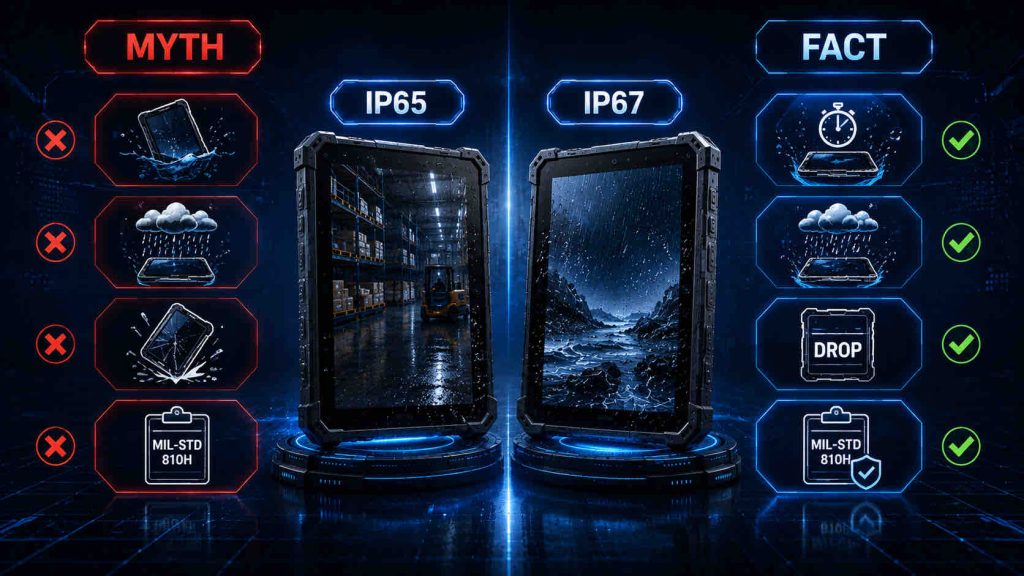
IP65 and IP67: Myth vs Fact
| Common Myth | What It Actually Means |
|---|---|
| IP67 means completely waterproof | IP67 addresses temporary immersion under specified test conditions. |
| IP65 cannot be used in rain | IP65 includes protection against water jets under defined conditions. |
| A higher IP rating means better drop resistance | IP ratings do not measure drop or impact performance. |
| IP67 automatically means MIL-STD-810H compliant | IP and MIL-STD-810H address different environmental factors. |
| Every industrial tablet should use IP67 | The correct rating depends on the actual water-exposure risk. |
Expert Tip
When comparing an IP65 vs IP67 rugged tablet, ask the supplier for the actual test standard, test conditions and product configuration.
Do not rely only on the IP label.
Also confirm drop resistance, operating temperature, vibration testing, port-cover requirements and accessory compatibility before making the final decision.
Quick Takeaway
IP65 and IP67 ratings describe protection against dust and water under defined test conditions.
They do not measure drop resistance, vibration performance or every other aspect of ruggedness.
IP67 does not mean unlimited waterproof operation, and IP65 does not mean the device must remain indoors.
The correct rating should always match the real environmental risk.
Part 8: IP65 vs IP67 Rugged Tablet by Industry
The right IP rating can vary significantly between industries because each working environment presents different levels of dust, rain, splashes and immersion risk.
When comparing an IP65 vs IP67 rugged tablet, businesses should evaluate the real operating conditions rather than choosing a rating based only on the industry name.
The examples below show which protection level is commonly more appropriate for different industrial applications.
1. Warehouse and Distribution Centers
Warehouses are typically controlled indoor environments where the main risks are dust, packaging debris, accidental splashes and cleaning water.
For inventory management, barcode scanning, receiving, shipping and order picking, an IP65 rugged tablet is often sufficient.
IP67 may only be necessary when the warehouse includes wash-down areas, outdoor yards or locations where temporary immersion is a realistic possibility.
For most standard warehouse workflows, IP65 usually offers a practical balance between protection, accessibility and cost.
2. Manufacturing and Production
Manufacturing facilities can expose tablets to dust, vibration, oils, cleaning processes and frequent handling.
IP65 is commonly suitable for production monitoring, quality inspection, maintenance records and material tracking when immersion is unlikely.
IP67 may be useful in food processing, wash-down areas or other manufacturing environments with higher water exposure.
Businesses should also evaluate vibration resistance, operating temperature and industrial interfaces in addition to the IP rating.
3. Logistics and Transportation
Logistics operations often move between warehouses, loading docks, vehicles and outdoor areas.
For indoor logistics, proof of delivery, route management and vehicle-mounted use, IP65 may provide sufficient protection.
For transportation yards, ports or outdoor loading areas exposed to heavy rain and standing water, IP67 can provide additional protection.
The correct choice depends on whether the device remains mainly inside vehicles and warehouses or is frequently used outdoors in wet conditions.
4. Mining and Heavy Industry
Mining environments combine dust, mud, rain, vibration and harsh outdoor conditions.
Because both IP65 and IP67 provide the same dust-protection classification, the main decision is the level of water exposure.
If the tablet is used mainly inside vehicles or covered areas, IP65 may be sufficient.
For workers who regularly operate outdoors in heavy rain, muddy conditions or areas where temporary immersion is possible, IP67 is often the more suitable choice.
5. Field Service and Maintenance
Field-service technicians may work in customer facilities, construction sites, outdoor installations and remote locations.
IP65 can be sufficient when the device is exposed mainly to dust, splashes and occasional rain.
IP67 becomes more valuable when technicians regularly work in heavy rain, around water infrastructure or in environments where accidental immersion is a realistic risk.
For field service, screen brightness, battery life, glove touch and cellular connectivity should also be evaluated together with the IP rating.
6. Public Safety and Emergency Response
Public safety teams may use rugged tablets in patrol vehicles, fire trucks, emergency-response units and outdoor incident scenes.
In vehicle-mounted or controlled environments, IP65 may be sufficient.
For search and rescue, disaster response, heavy rain or wet outdoor operations, IP67 can provide additional protection against temporary immersion and greater water exposure.
Because public-safety devices may also face drops, vibration and temperature changes, businesses should evaluate IP rating together with other durability requirements.
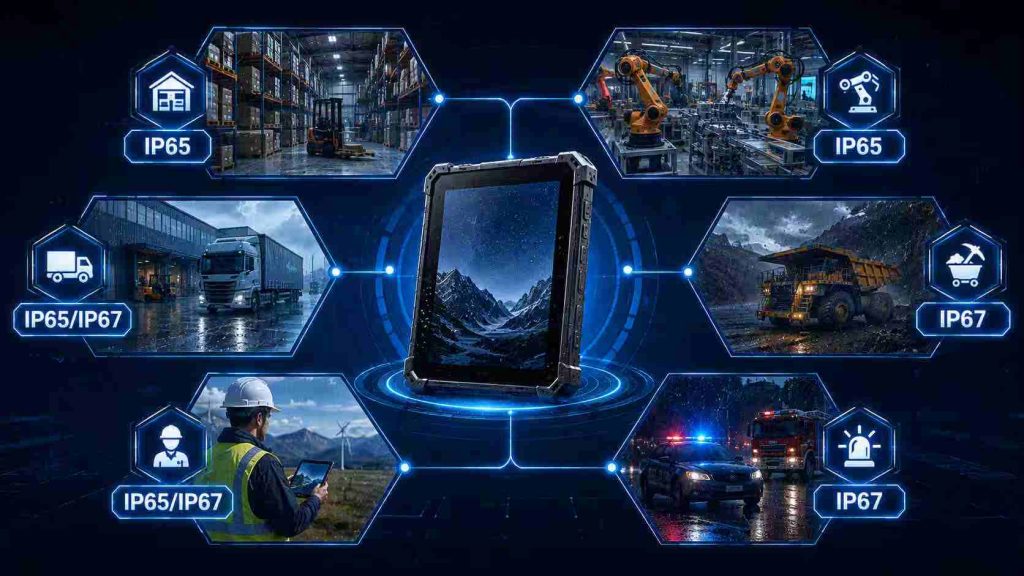
IP65 vs IP67 Rugged Tablet Industry Guide
| Industry | Typical Recommendation | Main Reason |
|---|---|---|
| Warehouse | IP65 | Dust, splashes and controlled indoor conditions |
| Manufacturing | Usually IP65 | Industrial dust and cleaning exposure |
| Logistics | IP65 / IP67 | Depends on indoor vs outdoor exposure |
| Mining | Often IP67 | Dust, mud, rain and wet outdoor conditions |
| Field Service | IP65 / IP67 | Depends on rain and immersion risk |
| Public Safety | Often IP67 | Outdoor emergency response and wet environments |
Quick Industry Guide
Choose IP65 for most controlled indoor industrial environments.
Choose IP67 when the application regularly involves heavy rain, wet outdoor work or temporary immersion risk.
For industries with mixed environments, evaluate the actual deployment location rather than applying one IP rating to every device.
Part 9: What to Ask Your Rugged Tablet Supplier Before Ordering
Choosing the correct IP rating is only part of the purchasing process.
Before ordering an IP65 or IP67 rugged tablet, businesses should confirm how the device was tested, which configuration was used, whether port covers must remain closed and what other durability standards apply.
Clear technical documentation can help buyers avoid misunderstandings and ensure that the delivered product matches the requirements of the real working environment.
1. Warehouse and Distribution Centers
Do not rely only on the IP65 or IP67 label shown on a product page.
Ask the supplier which standard was used for testing and whether test documentation is available.
For projects where environmental protection is critical, buyers should confirm the exact product model and configuration covered by the test.
If the tablet includes optional ports, scanners, batteries or accessories, verify whether those configurations affect the claimed protection level.
2. Confirm Whether Port Covers Must Be Closed
Many rugged tablets use sealed covers over USB, charging, audio or communication ports.
The IP rating may depend on these covers being fully closed during testing and operation.
Ask the supplier whether the device maintains the same protection level when ports are open, when the tablet is docked or when accessories are connected.
This is especially important for applications that require frequent access to USB, RJ45, RS232 or charging interfaces.
3. Ask About Drop-Test Performance
IP ratings do not measure drop resistance.
Ask the supplier for the tested drop height, the surface used during testing and whether the device was tested on multiple sides and corners.
For handheld warehouse, field-service or public-safety applications, drop resistance can be just as important as dust and water protection.
Buyers should therefore review drop-test information separately from the IP rating.
4. Ask Which MIL-STD-810H Methods Were Tested
If a rugged tablet is described as MIL-STD-810H tested, ask which specific environmental methods were applied.
MIL-STD-810H covers many different environmental conditions, including vibration, shock, temperature, humidity and other stresses.
A supplier should be able to explain which tests are relevant to the device rather than using the standard name as a general durability claim.
This helps buyers compare products more accurately.
5. Confirm the Operating Temperature Range
Industrial environments can become much hotter or colder than standard office conditions.
Ask for both the operating-temperature range and the storage-temperature range.
Cold-storage, outdoor winter, mining and vehicle-mounted applications may require wider temperature capability.
Temperature performance should be evaluated together with battery behavior, display performance and charging limitations.
6. Request a Sample Before Mass Ordering
A sample test is one of the most effective ways to reduce purchasing risk.
Test the device with your real software, Wi-Fi network, barcode labels, accessories, docks, gloves and working environment.
If water exposure is a key concern, verify the supplier’s recommended operating conditions rather than performing uncontrolled tests that could damage the device.
A successful pilot deployment can reveal compatibility or usability issues before a large order is placed.
7. Confirm Certifications, Warranty and Support
Buyers should also confirm the certifications required for the target market, such as CE, FCC, RoHS or other regional requirements.
Ask about warranty coverage, battery warranty, repair procedures, spare parts and long-term accessory availability.
For large industrial deployments, after-sales support and product lifecycle can be just as important as the initial specification.
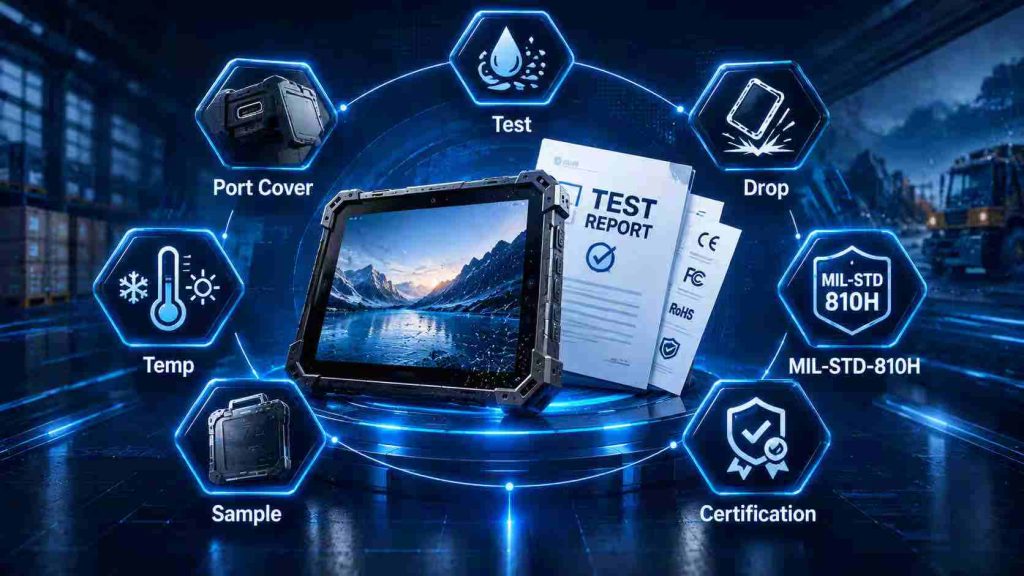
Rugged Tablet Supplier Checklist
| What to Ask | Why It Matters |
|---|---|
| IP test standard and report | Confirms the protection claim and tested configuration |
| Port-cover requirements | Shows whether sealing depends on closed covers |
| Drop-test height and surface | Helps evaluate physical impact resistance |
| MIL-STD-810H methods | Clarifies which environmental stresses were tested |
| Operating temperature | Confirms suitability for hot, cold or outdoor environments |
| Sample availability | Allows real-world compatibility testing |
| Certifications and warranty | Supports compliance and long-term deployment |
Before You Place an Order
Ask for documentation, not only marketing specifications.
Confirm the tested product configuration, port-cover conditions, drop resistance, environmental testing, temperature range, certifications and warranty.
For large deployments, always test a sample under real working conditions before confirming mass production.
Part 10: Frequently Asked Questions About IP65 vs IP67 Rugged Tablets
The following answers address common questions buyers ask when comparing an IP65 vs IP67 rugged tablet.
The main difference is water protection. Both IP65 and IP67 rugged tablets use the first digit “6”, which represents the same dust-protection classification. IP65 addresses protection against water jets under defined test conditions, while IP67 addresses temporary immersion under specified conditions.
No. IP67 provides a higher level of protection against water exposure, but it is not automatically the better choice for every application. For many warehouses, factories and vehicle-mounted environments, IP65 may provide sufficient protection at a more practical cost.
Yes. An IP65 rugged tablet can be suitable for outdoor use when the main risks are dust, splashes, water spray or occasional rain. If temporary immersion or heavier water exposure is a realistic risk, IP67 may be more appropriate.
No. IP67 does not mean unlimited underwater operation. It refers to protection against temporary immersion under specified test conditions. Buyers should confirm the manufacturer’s test conditions and operating instructions.
No. IP ratings describe protection against solid particles and liquids. Drop resistance, vibration and mechanical shock are separate durability characteristics and should be evaluated independently.
No. IP ratings focus on dust and water ingress protection, while MIL-STD-810H includes environmental test methods related to conditions such as shock, vibration, temperature and humidity. A rugged tablet may reference both, but they represent different aspects of durability.
For most indoor warehouse applications, IP65 is usually sufficient because the main environmental risks are dust, debris, splashes and cleaning water. IP67 may only be necessary when the warehouse includes wetter areas or a realistic risk of temporary immersion.
Yes. Sample testing can help confirm software compatibility, port-cover requirements, screen visibility, barcode performance, battery life, accessory compatibility and real-world environmental suitability before a large order is placed.
Conclusion: IP65 vs IP67 Rugged Tablet
Choosing between an IP65 and IP67 rugged tablet depends on the real working environment rather than simply selecting the higher rating.
Both ratings provide the same dust-protection classification, but they differ in water protection. IP65 is suitable for many warehouses, factories, logistics operations and field-service applications where dust, splashes and water spray are the main risks.
IP67 becomes more valuable when the device may face heavier water exposure or a realistic risk of temporary immersion.
Businesses should also evaluate port design, accessories, drop resistance, operating temperature, MIL-STD-810H testing, certifications and total project cost before making the final decision.
The best rugged tablet is the one whose protection level matches the actual application without unnecessary over-specification.
For a complete purchasing framework covering operating system, screen size, connectivity, battery, scanners and accessories, read our guide on how to choose a rugged tablet for industrial use.
Need Help Choosing Between IP65 and IP67?
Tell us your industry, working environment, water exposure, screen size, operating system, scanning, connectivity and customization requirements. Our team can recommend a suitable IP65 or IP67 rugged tablet configuration and arrange sample testing for your project.