MIL-STD-810H Rugged Tablet: What Does It Mean for Industrial Use?
MIL-STD-810H is frequently referenced when evaluating rugged tablets for demanding industrial environments.
However, the standard is often misunderstood. It is not simply a single “drop-proof” certification, and two rugged tablets associated with MIL-STD-810H may not necessarily have been evaluated using the same test methods or conditions.
Understanding what was actually tested is essential when selecting a rugged tablet for warehouses, manufacturing, transportation, field service and other demanding applications.
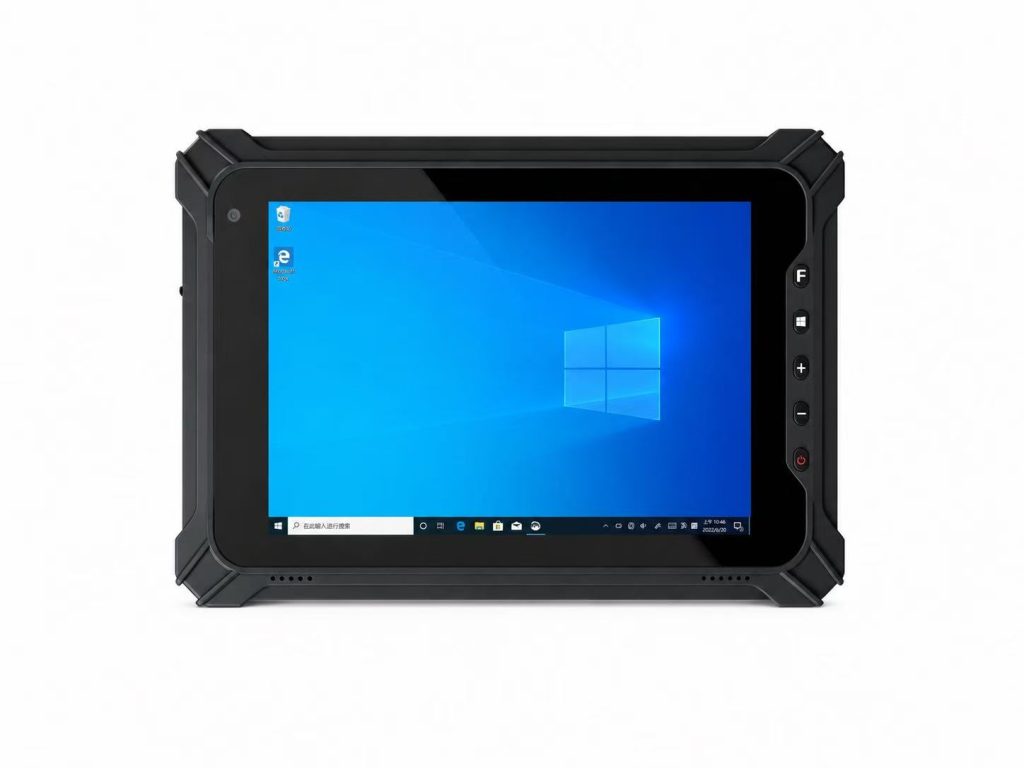
8-inch / 10-inch / 12-inch
Part 1: What Is MIL-STD-810H?
MIL-STD-810H is a U.S. Department of Defense environmental engineering standard that provides test methods for evaluating how equipment responds to environmental stresses during transportation, storage and operation.
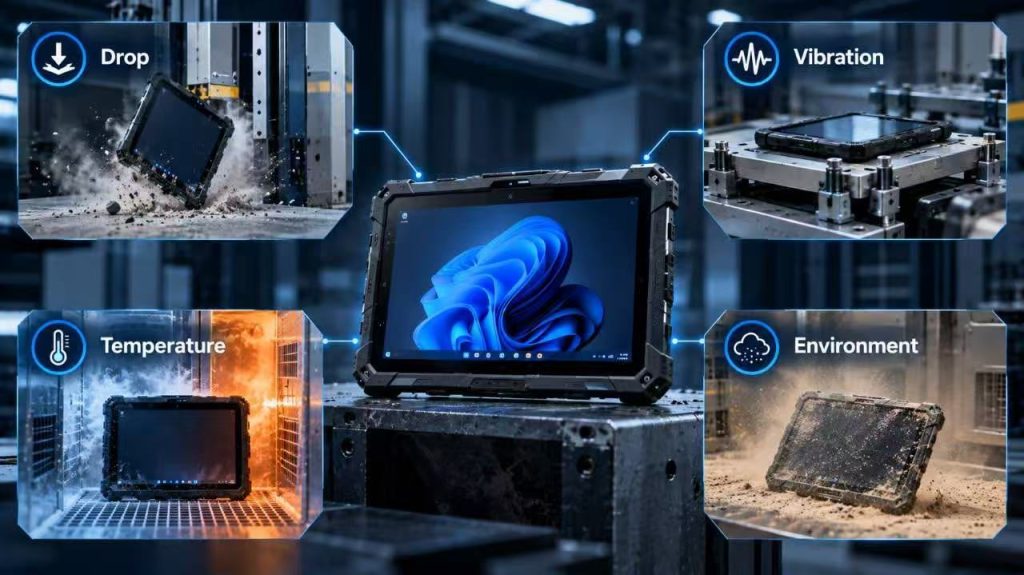
For rugged tablets, MIL-STD-810H may include testing related to mechanical shock, vibration, high and low temperatures, humidity, sand and dust, altitude and other demanding environmental conditions.
However, MIL-STD-810H should not be treated as a single durability rating. Different test methods can be selected according to the product and its intended application, so buyers should understand what was actually tested before comparing rugged tablets.
1. What Does MIL-STD-810H Mean?
MIL-STD-810H provides a framework for evaluating equipment against environmental conditions that may occur during its expected service life.
Instead of defining one universal test for every product, the standard contains multiple test methods covering different types of environmental stress.
For rugged tablets, relevant tests may include shock, vibration, temperature, humidity, sand and dust, depending on how and where the device will be used.
This makes MIL-STD-810H particularly relevant to industrial applications because a tablet used in a warehouse may face different environmental stresses from one installed in a forklift, carried by a field technician or used at a mining site.
The value of MIL-STD-810H therefore comes from understanding which tests are relevant to the actual deployment—not simply seeing the standard name on a specification sheet.
2. Is MIL-STD-810H a Military Certification?
MIL-STD-810H is sometimes described using terms such as “military-grade” or “military-certified,” but these terms can create confusion.
MIL-STD-810H is a U.S. Department of Defense test-method standard. A rugged tablet that references MIL-STD-810H has not necessarily been certified, approved or purchased by the U.S. military.
It also does not mean that the tablet has completed every test method contained in the standard.
Instead, manufacturers may evaluate a rugged tablet using selected MIL-STD-810H methods that are relevant to the product and its expected operating environment.
For industrial buyers, the more useful question is not whether a tablet is simply described as “military-grade,” but which MIL-STD-810H tests were actually performed and under what conditions.
3. What Environmental Conditions Does MIL-STD-810H Cover?
MIL-STD-810H contains test methods covering a wide range of environmental conditions that equipment may experience during transportation, storage and operation.
For rugged tablets, commonly relevant conditions can include mechanical shock, vibration, high temperature, low temperature, temperature shock, humidity, sand and dust, rain and low-pressure environments.
The importance of each condition depends on the application.
A handheld warehouse tablet may require greater attention to accidental drops and repeated handling, while a tablet installed in a forklift or truck may be exposed to continuous vibration.
Outdoor and field-service applications may place greater emphasis on temperature changes, moisture and dust, while mining and heavy-industry environments can expose devices to several environmental stresses at the same time.
This is why MIL-STD-810H testing should be considered in relation to the actual operating environment rather than as a simple list of tests.
| Environmental Condition | Why It Matters for Rugged Tablets |
|---|---|
| Mechanical Shock | Relevant to accidental impacts, handling and transportation |
| Vibration | Important for forklifts, trucks, vehicles and mobile equipment |
| High / Low Temperature | Relevant to outdoor, cold-storage and demanding industrial environments |
| Temperature Shock | Relevant when equipment moves rapidly between different temperature conditions |
| Humidity | Important in warm, moisture-rich or changing environments |
| Sand & Dust | Relevant to construction, mining and dusty industrial locations |
| Rain / Moisture | Important for outdoor and field applications |
| Low Pressure / Altitude | May be relevant to transportation or operation at higher elevations |
4. Do Rugged Tablets Need to Pass Every MIL-STD-810H Test?
No. A rugged tablet does not need to complete every test method contained in MIL-STD-810H.
The standard uses an environmental tailoring approach, meaning that test methods should be selected according to the environmental stresses that are relevant to the equipment and its expected service conditions.
For example, vibration testing may be particularly important for a tablet installed in a forklift or truck, while shock and drop resistance may be a higher priority for a handheld device used in a warehouse.
A field-service tablet may need greater consideration of temperature, humidity, dust and other outdoor environmental conditions.
This also means that two rugged tablets can both reference MIL-STD-810H without having completed exactly the same tests.
When comparing products, buyers should therefore review the relevant test methods and conditions instead of assuming that every MIL-STD-810H claim represents the same level of testing.
5. Why MIL-STD-810H Matters for Industrial Buyers
Industrial tablets are often used in environments where ordinary consumer devices may face greater risks of damage or performance problems.
Warehouses, factories, logistics operations, vehicles, field-service locations and heavy-industry sites can expose tablets to impacts, vibration, temperature changes, dust, moisture and continuous daily handling.
MIL-STD-810H test information can help buyers understand whether a rugged tablet has been evaluated against environmental stresses that are relevant to these conditions.
However, the standard should be used as part of the product evaluation process rather than as the only purchasing criterion.
Buyers should consider MIL-STD-810H together with IP protection, operating temperature, display visibility, battery performance, connectivity, mounting requirements and other specifications that affect the real industrial workflow.
The objective is not to choose the tablet with the longest list of test claims, but to choose a device whose durability characteristics match the actual deployment.
Official Reference:
MIL-STD-810H is titled “Environmental Engineering Considerations and Laboratory Tests” and uses an environmental tailoring approach to relate environmental test methods to the equipment and its expected service conditions.
For official MIL-STD-810 documentation, refer to the U.S. Department of Defense DLA ASSIST database.
Quick Recommendation
Do not select a rugged tablet simply because the specification sheet includes the words “MIL-STD-810H.”
First identify the environmental stresses that are most relevant to your application, such as drops, vibration, temperature, humidity or dust.
Then confirm which MIL-STD-810H tests were actually performed and whether the test conditions are relevant to the way the tablet will be used.
For industrial procurement, relevant and clearly documented testing is more valuable than a long list of durability claims without context.

Part 2: Key MIL-STD-810H Tests for Rugged Tablets
MIL-STD-810H includes many environmental test methods, but not every method is equally important for every rugged tablet application.
For industrial users, the most relevant tests usually depend on how the tablet will be handled, transported, mounted and operated in the real working environment.
Drop and mechanical shock, vibration, high and low temperatures, humidity, and sand and dust are among the conditions commonly considered when evaluating rugged tablets for demanding applications.
Understanding what each test evaluates can help buyers focus on the durability requirements that matter most for their project rather than simply comparing the number of MIL-STD-810H claims on a specification sheet.
1. Drop and Mechanical Shock Testing
Mechanical shock is particularly important for rugged tablets that are carried and handled throughout the working day.
Warehouse workers, logistics operators and field technicians may move between different work areas while carrying a tablet, increasing the possibility of accidental drops or impacts.
MIL-STD-810H Method 516.8 addresses mechanical shock and includes procedures for different shock environments.
When evaluating a rugged tablet, buyers should look beyond a simple drop-height claim and consider the applicable test procedure, impact conditions, device configuration and post-test functionality.
Drop and mechanical shock testing will be examined in greater detail later in this guide.
2. Vibration Testing
Vibration is a different type of mechanical stress from a sudden drop or impact.
A rugged tablet installed in a forklift, truck, construction vehicle or industrial machine may experience repeated vibration for extended periods of time.
MIL-STD-810H Method 514.8 addresses vibration environments and can be particularly relevant to vehicle-mounted and mobile industrial equipment.
For buyers, the key consideration is whether the vibration testing reflects the type of movement and operating conditions the tablet is expected to experience.
This becomes especially important when the tablet is used together with a vehicle dock or mounting system, because the complete installation can influence how vibration is transferred to the device.
Vibration testing will be covered in greater detail in Part 4.
3. High and Low Temperature Testing
Industrial tablets are not always used in temperature-controlled indoor environments.
Outdoor worksites, vehicles, cold-storage facilities, warehouses and industrial plants can expose devices to temperatures that are significantly different from normal office conditions.
MIL-STD-810H includes methods for evaluating equipment under high-temperature and low-temperature environments.
For rugged tablet buyers, temperature testing can help determine whether a device has been evaluated for the environmental conditions expected during storage or operation.
However, test temperatures should not automatically be treated as the same thing as the manufacturer’s specified operating-temperature range.
Buyers should review both the environmental test information and the product’s normal operating specifications when selecting a tablet for hot or cold environments.
4. Humidity Testing
Humidity can affect electronic equipment in warm, moisture-rich and changing environmental conditions.
This can be relevant to rugged tablets used in outdoor operations, transportation, utilities, field service and industrial environments where temperature and moisture levels may vary.
MIL-STD-810H includes humidity testing intended to evaluate equipment under defined humid environmental conditions.
For buyers, the importance of humidity testing depends on the expected deployment rather than simply whether the test appears on the specification sheet.
A tablet used mainly inside a controlled office or warehouse may face different humidity requirements from a device regularly used outdoors or moved between different environmental conditions.
Humidity resistance should also be considered together with the tablet’s IP rating when moisture or water exposure is an important project requirement.
5. Sand and Dust Testing
Dust exposure can be a major concern in construction, mining, manufacturing, utilities and other demanding industrial environments.
Fine particles can accumulate around ports, connectors, ventilation areas and enclosure joints, making dust protection an important consideration for rugged tablet design.
MIL-STD-810H includes methods for evaluating equipment in sand and dust environments.
For industrial buyers, this type of testing can provide useful information when tablets are expected to operate in dusty outdoor or heavy-industry locations.
However, MIL-STD-810H sand and dust testing should not be confused with the dust-protection level defined by an IP rating.
The two standards evaluate different aspects of environmental protection and should be considered together when dust exposure is a significant project requirement.
Key MIL-STD-810H Tests at a Glance
| Test Area | Relevant Condition | Typical Industrial Applications |
|---|---|---|
| Mechanical Shock | Drops, impacts and handling-related shock | Warehousing, logistics, field service |
| Vibration | Repeated mechanical movement | Forklifts, trucks, vehicles, machinery |
| High / Low Temperature | Hot or cold environments | Outdoor work, cold storage, vehicles |
| Humidity | Warm and moisture-rich conditions | Field service, utilities, transportation |
| Sand & Dust | Dusty and particle-rich environments | Mining, construction, manufacturing |
Quick Recommendation
Do not choose MIL-STD-810H tests based on the longest specification list.
Instead, identify the environmental stresses that are most likely to occur in your actual application.
For handheld warehouse and logistics tablets, mechanical shock and drop resistance may be a priority.
For forklifts, trucks and vehicle-mounted systems, vibration can become especially important.
For outdoor, field-service, mining and heavy-industry applications, temperature, humidity, sand and dust may require greater attention.
The most useful MIL-STD-810H test information is the information that matches the real conditions in which the rugged tablet will operate.

Part 3: MIL-STD-810H Drop and Shock Resistance
Drops and mechanical shocks are among the most important durability concerns when evaluating a MIL-STD-810H rugged tablet for handheld industrial applications.
Warehouse workers, logistics operators, field technicians and other mobile users may carry a tablet throughout the working day, creating the possibility of accidental drops, impacts and handling-related shock.
MIL-STD-810H Method 516.8 addresses mechanical shock, but a reference to this method should not be interpreted as one universal drop-resistance rating.
For industrial buyers, understanding how a tablet was tested is more useful than looking at the drop-height number alone. The test conditions, impact surface, device orientation, product configuration and post-test functionality can all help provide context for a drop or shock claim.
1. What Does Drop Resistance Mean?
Drop resistance describes a device’s ability to withstand defined impacts associated with falling or handling.
For a rugged tablet, a manufacturer may specify a tested drop height, such as 1.2 meters, together with particular test conditions.
This type of information can be useful for industrial users because handheld tablets are more likely to experience accidental drops than devices permanently installed in a fixed location.
However, a drop-height specification should not be interpreted by itself. The height is only one part of the test conditions used to evaluate the device.
When comparing rugged tablets, buyers should therefore ask how the drop test was performed rather than assuming that two products with the same stated drop height have demonstrated identical durability.
2. How Is Drop Testing Related to MIL-STD-810H?
MIL-STD-810H Method 516.8 addresses mechanical shock and includes different procedures intended to represent different shock environments.
Transit drop testing is one type of shock evaluation that may be relevant to portable equipment that can experience drops during handling, transportation or service.
For rugged tablets, this can provide useful durability information when the device is regularly carried between work areas or used as a handheld terminal.
However, Method 516.8 is broader than a single drop test, and not every reference to Method 516.8 means that exactly the same procedure or test conditions were used.
Buyers should therefore confirm the applicable test procedure and conditions when MIL-STD-810H shock resistance is an important project requirement.
3. Why Drop Height Is Not the Only Factor
Drop height is easy to compare on a specification sheet, which is why it often receives the most attention.
However, two rugged tablets tested from the same height may still have been evaluated under different conditions.
The impact surface can influence the severity of the shock transferred to the device. The number of drops, device orientation and product configuration can also affect how the test should be interpreted.
A tablet dropped once under a controlled condition does not necessarily represent the same evaluation as a device subjected to multiple defined impacts on different areas of the enclosure.
For industrial procurement, the stated drop height should therefore be considered together with the complete test conditions rather than treated as a standalone measure of ruggedness.
4. Why Impact Surface and Device Orientation Matter
The surface and orientation used during a drop test can significantly influence how mechanical energy is transferred to a rugged tablet.
An impact against a hard surface can create a different mechanical load from an impact against a softer or more energy-absorbing surface.
Device orientation also matters because a tablet may land on its face, back, edge or corner during an accidental drop.
Edges and corners can concentrate impact forces into smaller areas of the enclosure, while face impacts may place different stresses on the display and overall structure.
This is why professional buyers should look beyond statements such as “1.2 m drop resistant” and consider whether the test conditions provide useful evidence for the surfaces and handling risks present in the actual workplace.
5. What Should Buyers Check After a Drop Test?
Surviving a drop does not only mean that the tablet enclosure remains visually intact.
After mechanical shock exposure, the device should be evaluated according to the functional requirements that matter for the intended application.
For a rugged tablet, relevant functions may include the display, touchscreen, physical buttons, charging, external ports, wireless communication and any optional modules installed in the tested configuration.
A device may show little visible damage while still experiencing a functional problem, so post-test operation can be just as important as physical appearance.
For project-based procurement, buyers should confirm what acceptance criteria were used and whether the tested tablet continued to perform the functions required by the application.
What to Check in a Rugged Tablet Drop Test
| Test Detail | Why It Matters |
|---|---|
| Drop Height | Indicates the defined height used during the test |
| Impact Surface | Influences how impact energy is transferred to the tablet |
| Device Orientation | Shows whether different faces, edges or corners were evaluated |
| Number of Drops | Provides context for repeated impact exposure |
| Product Configuration | Confirms which tablet hardware and options were tested |
| Operating Condition | Indicates whether the device was operating during relevant testing |
| Post-Test Functionality | Helps confirm whether required functions remained operational |
6. Which Industrial Applications Need Strong Drop Resistance?
Drop resistance is especially important in applications where rugged tablets are frequently carried, handled or transferred between workers.
In warehouses and logistics operations, tablets may be used while workers move between aisles, loading areas, vehicles and inventory locations.
Field-service technicians may carry devices between vehicles, outdoor sites and customer locations, while manufacturing workers may use tablets around production lines, tools and industrial equipment.
Public-safety and other mobile applications can also involve frequent handling in changing environments.
By contrast, a tablet that remains permanently installed in a vehicle or fixed workstation may have a lower risk of ordinary handheld drops, while vibration and mounting-related mechanical stresses can become more important.
The durability priorities should therefore reflect how the tablet will actually be deployed.
Quick Recommendation
Do not compare rugged tablets using drop height alone.
For handheld industrial applications, review the stated drop height together with the impact surface, device orientation, number of exposures, tested product configuration and post-test functionality.
A 1.2 m or similar drop-resistance claim becomes much more useful when the conditions behind the test are clearly documented.
For vehicle-mounted tablets, also consider vibration and mounting-related mechanical stresses rather than relying only on handheld drop performance.
The best durability specification is the one that reflects the real risks of your deployment.
Official Reference:
MIL-STD-810H Method 516.8 addresses mechanical shock and includes different procedures intended to represent different shock environments.
Because the applicable procedure and test conditions can vary according to the equipment and its expected service environment, buyers should review the actual test information rather than treating “MIL-STD-810H” as one universal drop rating.
For official test methods and procedures, refer to the U.S. Department of Defense DLA ASSIST database.

Part 4: MIL-STD-810H Vibration Testing
Vibration is one of the most important durability considerations when evaluating a MIL-STD-810H rugged tablet for vehicles, forklifts and other mobile industrial equipment.
Unlike an accidental drop, which creates a short-duration impact, vibration can expose a device to repeated mechanical movement over extended periods of operation.
MIL-STD-810H Method 514.8 addresses vibration environments and provides a framework for evaluating how equipment responds to these mechanical stresses.
For industrial buyers, the important question is not simply whether a rugged tablet has been “vibration tested,” but whether the test conditions are relevant to the vehicle, machinery, mounting system and operating environment in which the device will actually be used.
1. What Is MIL-STD-810H Vibration Testing?
MIL-STD-810H Method 514.8 addresses vibration environments that equipment may experience during transportation and operation.
The objective is not simply to make a device shake for a fixed period of time. Vibration testing is intended to represent relevant mechanical environments according to the equipment and its expected service conditions.
For rugged tablets, vibration can be particularly important when a device is installed in a forklift, truck, construction vehicle, agricultural machine or other mobile platform.
Repeated vibration can place mechanical stress on the tablet enclosure, internal components, connectors, mounting points and other parts of the system.
This is why vibration resistance should be evaluated according to the actual deployment rather than treated as a generic durability claim.
2. How Is Vibration Different from Drop and Shock?
Drop, shock and vibration all create mechanical stress, but they do not represent the same type of exposure.
An accidental drop usually creates a relatively short-duration impact when the tablet contacts a surface.
Vibration, by contrast, can involve repeated mechanical movement over a much longer period of time.
A handheld warehouse tablet may therefore require strong resistance to accidental drops, while a tablet mounted inside a forklift or truck may need greater attention to repeated vibration.
In some industrial applications, both types of durability are important. A tablet may spend part of the day mounted in a vehicle and another part being carried by an operator.
For this reason, shock and vibration test information should be evaluated separately according to how the rugged tablet will actually be deployed.
3. Why Vibration Matters for Vehicle-Mounted Rugged Tablets
Vehicle-mounted rugged tablets can experience mechanical vibration throughout normal operation.
Forklifts may travel repeatedly across warehouse floors, loading areas, ramps and uneven surfaces, while trucks and service vehicles can expose equipment to road vibration for extended periods.
Construction, mining and agricultural vehicles may operate on even rougher terrain and can create more demanding mechanical environments.
Because the tablet is attached to the vehicle, vibration can be transferred through the vehicle structure, mounting system and dock into the device.
For buyers selecting a vehicle-mounted rugged tablet, vibration resistance should therefore be considered together with the dock, mounting method and expected operating environment.
A durable tablet alone does not automatically guarantee that every mounting configuration will perform identically under vibration.
4. Forklift, Truck and Heavy-Equipment Applications
Different vehicles can expose rugged tablets to different vibration environments.
In warehouses and logistics centers, forklift-mounted tablets may experience frequent movement, repeated starts and stops, floor joints, ramps and loading-area surfaces.
Truck-mounted tablets may be exposed to road vibration for longer periods, while field-service vehicles can combine highway travel with rougher local roads and worksite conditions.
Mining, construction and other heavy-equipment applications may introduce additional vibration and mechanical loads because of rough terrain and demanding operating conditions.
These environments should not automatically be treated as equivalent.
When vibration performance is important, buyers should consider whether the available test information is relevant to the type of vehicle and operating conditions involved in the project.
5. Why the Mounting System Matters
The mounting system can influence how vibration is transferred from a vehicle or machine to a rugged tablet.
A tablet installed in a vehicle dock is part of a larger mechanical system that may include brackets, mounting arms, fasteners, connectors and power interfaces.
The design and installation of these components can affect the mechanical loads experienced by the tablet during operation.
This means that testing a tablet by itself does not necessarily provide all the information required to evaluate every possible vehicle-mounted installation.
For projects involving forklifts, trucks or heavy equipment, buyers should consider both the rugged tablet and the mounting system when reviewing vibration requirements.
Where appropriate, the supplier should also confirm whether the tested configuration reflects the dock or mounting arrangement planned for the project.
6. What Should Buyers Check About Vibration Testing?
A specification that simply states “MIL-STD-810H vibration tested” provides limited information about the actual evaluation.
Buyers should first confirm that Method 514.8 is relevant to the product claim and then review the available information about the test conditions.
The vibration environment, test duration, device configuration and mounting condition can all provide useful context when comparing rugged tablets.
For vehicle-mounted projects, it is also important to determine whether the tablet was evaluated alone or together with relevant docking or mounting hardware.
The goal is not to compare products by counting test claims. It is to determine whether the available vibration test information reflects the mechanical environment expected in the real application.
What to Check in Rugged Tablet Vibration Testing
| Test Detail | Why It Matters |
|---|---|
| Test Method | Helps identify whether the vibration evaluation references the applicable MIL-STD-810H method |
| Vibration Environment | Provides context for the type of mechanical movement represented during testing |
| Test Duration | Helps indicate how long the device was exposed to the defined vibration conditions |
| Product Configuration | Confirms which tablet hardware and optional components were evaluated |
| Mounting Condition | Shows how the tablet was secured or installed during relevant testing |
| Dock / Mounting Hardware | Helps determine whether relevant vehicle-mounting components were included in the evaluation |
| Post-Test Functionality | Helps confirm whether required tablet functions remained operational after exposure |
Quick Recommendation
For handheld rugged tablets, vibration may be less important than accidental drops and repeated handling.
For forklifts, trucks, construction vehicles and other vehicle-mounted applications, vibration should receive much greater attention.
Do not evaluate vibration resistance from the words “MIL-STD-810H tested” alone.
Review the applicable vibration test information together with the vehicle type, operating environment, tablet configuration and mounting system.
For vehicle-mounted projects, the most useful durability evidence is testing that reflects the mechanical conditions the complete installation is expected to experience.

Part 5: Temperature and Environmental Testing
A MIL-STD-810H rugged tablet may be exposed to environmental conditions that are very different from those found in a typical office.
Outdoor worksites, vehicles, cold-storage facilities, factories and remote field locations can expose devices to high temperatures, low temperatures, rapid temperature changes and high humidity.
MIL-STD-810H includes test methods that can be used to evaluate equipment under these climatic conditions.
For industrial buyers, the important question is not simply whether a tablet has been “temperature tested,” but whether the applicable test conditions are relevant to the environment in which the device will be stored, transported and operated.
1. High Temperature Testing
High-temperature environments can affect electronic devices used outdoors, inside vehicles and around industrial equipment.
MIL-STD-810H Method 501.7 addresses high-temperature environments and can be used to evaluate how equipment responds to defined high-temperature conditions.
For rugged tablets, high-temperature testing may be relevant to field service, transportation, utilities, construction and other applications where devices can be exposed to significant heat.
Storage and operation should also be considered separately. A tablet stored inside a hot vehicle, for example, may experience different conditions from a device actively used outdoors during a work shift.
Buyers should therefore review the applicable test information together with the manufacturer’s specified storage and operating temperature ranges.
2. Low Temperature Testing
Low temperatures can create different challenges for rugged tablets used in cold-storage facilities, winter field operations and outdoor industrial environments.
MIL-STD-810H Method 502.7 addresses low-temperature environments and can be relevant when equipment is expected to experience cold conditions during storage or operation.
For rugged tablets, buyers should consider not only whether the device has been evaluated under low-temperature conditions, but also whether important functions remain suitable for the intended workflow.
Display performance, touchscreen response, battery behavior and other device functions can become important considerations in cold environments.
As with high-temperature testing, the MIL-STD-810H test information should be reviewed together with the tablet’s specified operating and storage temperature ranges.
3. Temperature Shock Testing
Temperature shock is different from simply operating a rugged tablet in a hot or cold environment.
MIL-STD-810H Method 503.7 addresses rapid changes between temperature conditions.
This can be relevant when equipment moves between environments with significantly different temperatures rather than remaining under one stable condition.
For example, a rugged tablet may move between a temperature-controlled facility and an outdoor work area, or between a heated vehicle and a cold external environment.
Rapid temperature transitions can create different stresses from long-term exposure to a constant temperature.
Industrial buyers should therefore consider not only the maximum and minimum temperatures of the application, but also whether the tablet may experience repeated or rapid transitions between different environmental conditions.
4. Humidity Testing
Humidity can become an important environmental factor when rugged tablets are used in warm, moisture-rich or changing climatic conditions.
MIL-STD-810H Method 507.6 addresses humidity environments and can help evaluate how equipment responds to defined combinations of moisture and temperature.
This may be relevant to field service, utilities, transportation, outdoor operations and industrial facilities where humidity levels can vary significantly.
Humidity exposure should not be confused with direct water-ingress protection. A humidity test and an IP water-protection rating evaluate different environmental concerns.
For projects involving moisture, rain or water exposure, buyers should therefore consider MIL-STD-810H environmental testing together with the tablet’s IP rating and actual deployment conditions.
5. Operating Temperature vs MIL-STD-810H Testing
A rugged tablet’s operating temperature range and its MIL-STD-810H temperature test information are related, but they should not automatically be treated as the same specification.
The operating temperature range describes the temperatures within which the manufacturer specifies that the tablet is intended to operate under defined conditions.
MIL-STD-810H testing, by contrast, evaluates equipment using particular environmental test methods and conditions.
A temperature reached during an environmental test does not automatically mean that the tablet is specified for continuous normal operation at that same temperature.
For industrial procurement, buyers should therefore review both pieces of information: the product’s specified operating and storage temperature ranges, and the relevant MIL-STD-810H test conditions.
This is particularly important for cold storage, outdoor field work, hot vehicles and other applications where temperature is a critical part of the project specification.
6. Which Industrial Applications Need Greater Temperature Protection?
The importance of temperature and climatic testing depends strongly on where the rugged tablet will be deployed.
Cold-storage and refrigerated logistics applications may place greater emphasis on low-temperature performance and transitions between cold and warmer environments.
Field service, utilities and outdoor operations may expose tablets to changing temperatures, humidity and weather conditions throughout the working day.
Tablets used inside trucks, service vehicles or heavy equipment can also experience significant temperature changes when vehicles are parked or operated in different climates.
Manufacturing environments may introduce localized heat or changing conditions depending on the production process.
For these applications, buyers should define the expected storage, transportation and operating environment before comparing rugged tablet temperature specifications.
Key Temperature and Environmental Tests at a Glance
| Test Area | What It Evaluates | Typical Industrial Relevance |
|---|---|---|
| High Temperature | Exposure to defined high-temperature conditions | Outdoor work, hot vehicles, utilities and industrial environments |
| Low Temperature | Exposure to defined low-temperature conditions | Cold storage, refrigerated logistics and winter field work |
| Temperature Shock | Rapid transitions between different temperature conditions | Indoor-to-outdoor workflows, vehicles and changing climates |
| Humidity | Exposure to defined warm and moisture-rich conditions | Field service, utilities, transportation and outdoor operations |
Quick Recommendation
Do not evaluate a rugged tablet’s temperature capability from a single MIL-STD-810H claim or temperature number.
First identify the temperatures the device may experience during storage, transportation and actual operation.
For cold storage and winter field work, pay particular attention to low-temperature performance and transitions between different environments.
For outdoor, vehicle and industrial applications, high temperature, temperature shock and humidity may also become important.
Finally, compare the relevant MIL-STD-810H test information with the manufacturer’s specified operating and storage temperature ranges. Both are important when determining whether a rugged tablet is suitable for the project.

Part 6: MIL-STD-810H vs IP65 and IP67
MIL-STD-810H and IP ratings are both commonly used when evaluating rugged tablets, but they describe different aspects of environmental durability.
MIL-STD-810H provides test methods for environmental stresses such as shock, vibration, temperature, humidity and other conditions relevant to the equipment and its intended service environment.
IP ratings, by contrast, classify the level of protection provided by an enclosure against the ingress of solid objects and water.
For industrial buyers, MIL-STD-810H and IP65 or IP67 should therefore be viewed as complementary information rather than interchangeable durability ratings.
1. What Does MIL-STD-810H Evaluate?
MIL-STD-810H provides a framework for evaluating equipment against environmental stresses that may occur during transportation, storage and operation.
For rugged tablets, relevant test methods can address mechanical shock, vibration, high and low temperatures, temperature shock, humidity, sand and dust, and other environmental conditions.
The applicable tests depend on the device and its expected service environment, which is why a MIL-STD-810H claim should be reviewed together with the specific test information.
MIL-STD-810H therefore provides a broader environmental testing framework than a simple enclosure-ingress rating.
However, it should not be interpreted as a replacement for an IP rating when dust or water ingress protection is an important project requirement.
2. What Does an IP Rating Evaluate?
An IP rating describes the level of protection provided by an enclosure against the ingress of solid foreign objects and water.
The rating uses two digits.
The first digit describes protection against solid objects and dust, while the second digit describes protection against water under defined test conditions.
For rugged tablets, IP ratings are particularly useful when the device may be exposed to dust, rain, splashes, cleaning processes or other environments where enclosure protection is important.
Unlike MIL-STD-810H, an IP rating does not describe the tablet’s resistance to mechanical shock, vibration or temperature extremes.
3. What Does IP65 Mean for a Rugged Tablet?
For an IP65-rated rugged tablet, the first digit “6” indicates the highest level of protection against dust ingress within the IP classification system.
The second digit “5” indicates protection against water jets under defined test conditions.
In practical industrial use, IP65 can be relevant to warehouses, manufacturing, logistics, field service and outdoor applications where tablets may encounter dust, splashes or rain.
However, IP65 should not be interpreted as meaning that the tablet is designed for continuous underwater use.
Buyers should consider the IP rating together with the actual type, duration and severity of water or dust exposure expected in the application.
4. What Does IP67 Mean for a Rugged Tablet?
IP67 also uses “6” as the first digit, indicating dust-tight enclosure protection.
The second digit “7” represents protection against temporary immersion in water under the conditions defined by the applicable IP test.
This can make IP67 relevant to applications where accidental immersion or more demanding water exposure is a realistic risk.
However, IP67 should not automatically be interpreted as “better in every way” than IP65.
The two ratings address different water-exposure conditions, and the most appropriate protection level depends on how the rugged tablet will actually be used.
For industrial procurement, the objective is to select an enclosure rating that matches the real environmental risk rather than simply choosing the largest IP number.
5. Does MIL-STD-810H Replace an IP Rating?
No. MIL-STD-810H and IP ratings evaluate different aspects of ruggedness.
A MIL-STD-810H rugged tablet may have strong shock, vibration and temperature test information while still requiring a separate IP rating to describe its enclosure protection against dust and water.
Similarly, an IP65 or IP67 tablet may provide strong dust and water ingress protection without automatically demonstrating resistance to drops, vibration or temperature extremes.
For demanding industrial applications, buyers often need to consider both types of information.
MIL-STD-810H can help evaluate relevant environmental and mechanical stresses, while the IP rating provides a clearer indication of enclosure protection against solids and water.
6. Which Protection Does Your Application Need?
The right combination of MIL-STD-810H testing and IP protection depends on the operating environment.
A warehouse tablet may require strong drop resistance and dust protection, while a forklift-mounted tablet may place greater emphasis on vibration together with suitable enclosure protection.
Outdoor field-service applications may require resistance to drops, temperature changes, dust and rain.
Mining, construction and heavy-industry environments can combine several of these risks, making both environmental testing and enclosure protection important.
Buyers should therefore begin with the actual hazards of the application and then determine which MIL-STD-810H tests and IP rating provide relevant evidence for those conditions.
The goal is not to collect the highest number of durability claims, but to select a rugged tablet whose protection matches the real deployment.
MIL-STD-810H vs IP65 vs IP67 at a Glance
| Protection / Standard | What It Evaluates | Typical Relevance for Rugged Tablets |
|---|---|---|
| MIL-STD-810H | Environmental stresses such as shock, vibration, temperature, humidity and other selected conditions | Mechanical durability and environmental suitability for demanding industrial applications |
| IP65 | Dust-tight enclosure protection and protection against water jets under defined conditions | Warehouses, manufacturing, logistics, field service and many outdoor applications |
| IP67 | Dust-tight enclosure protection and protection against temporary water immersion under defined conditions | Applications where accidental immersion or more demanding water exposure may be a realistic risk |
Quick Recommendation
Do not choose between MIL-STD-810H and an IP rating as if they were competing durability standards.
For industrial rugged tablets, the two types of information serve different purposes.
Use MIL-STD-810H test information to evaluate relevant mechanical and environmental stresses such as drops, vibration and temperature.
Use the IP rating to evaluate the enclosure’s protection against dust and water ingress.
For many industrial applications, a rugged tablet should provide an appropriate combination of both. The correct combination depends on the actual hazards of the deployment rather than simply selecting the highest specification available.

Part 7: MIL-STD-810G vs MIL-STD-810H
MIL-STD-810G and MIL-STD-810H are different revisions of the same U.S. Department of Defense environmental engineering standard.
MIL-STD-810H is the newer revision and includes updates to environmental test methods, procedures and technical guidance.
For rugged tablet buyers, however, the revision letter alone should not be used as a direct measure of product durability.
A tablet associated with MIL-STD-810H is not automatically more durable than every tablet tested according to MIL-STD-810G. The specific methods, procedures, test conditions and product configuration still need to be reviewed.
1. What Is MIL-STD-810G?
MIL-STD-810G is an earlier revision of the MIL-STD-810 environmental engineering standard.
It has been widely referenced for rugged computers, industrial electronics and other equipment that may be exposed to demanding environmental conditions.
Like other revisions of MIL-STD-810, it contains multiple environmental test methods rather than one universal durability test.
For rugged tablets, MIL-STD-810G claims may refer to selected tests involving shock, vibration, temperature, humidity, sand, dust or other environmental conditions.
This means that a product described as “MIL-STD-810G tested” should still be evaluated according to the actual methods and conditions used.
2. What Is MIL-STD-810H?
MIL-STD-810H is a later revision of the MIL-STD-810 standard and updates the environmental engineering guidance and test methods used to evaluate equipment.
The revision includes updated technical information, test procedures and environmental tailoring guidance.
For rugged tablet buyers, MIL-STD-810H can indicate that the product has been evaluated with reference to a more recent version of the standard.
However, the presence of the letter “H” does not by itself explain which tests were performed, how demanding the conditions were or whether the test configuration matches the intended industrial application.
The specific test documentation remains more important than the revision letter alone.
3. What Changed from MIL-STD-810G to MIL-STD-810H?
The transition from MIL-STD-810G to MIL-STD-810H involved revisions to technical guidance, environmental data, test methods and procedures.
Some methods were updated to reflect improved understanding of environmental stresses and how equipment should be evaluated.
For industrial buyers, the practical significance of these changes depends on the specific test being considered.
A change in the standard revision does not mean that every test became universally more severe.
Instead, the updated revision provides newer guidance and revised procedures that manufacturers and test laboratories can use when evaluating equipment.
This is why it is more useful to compare the actual method and test conditions than to assume that MIL-STD-810H always represents a higher durability level than MIL-STD-810G.
4. Is MIL-STD-810H More Rugged Than MIL-STD-810G?
Not necessarily.
MIL-STD-810H is a newer revision, but the revision itself does not determine the ruggedness of a tablet.
Two products can reference different revisions of MIL-STD-810 while also being tested using different methods, procedures, test severities and device configurations.
For example, one tablet may reference MIL-STD-810H but provide limited information about the test conditions, while another product may have detailed MIL-STD-810G test documentation that is highly relevant to the intended application.
For industrial procurement, the quality and relevance of the test evidence are more important than simply choosing the product with the newest revision letter.
5. Should Buyers Prefer MIL-STD-810H?
When all other factors are comparable, test information based on a more recent revision can be useful because it reflects newer environmental engineering guidance.
However, buyers should not reject a rugged tablet solely because its documentation references MIL-STD-810G.
The better approach is to review which environmental tests were performed, whether the test conditions are relevant to the application and whether supporting documentation is available.
For new industrial projects, MIL-STD-810H may be preferable when suppliers can provide clear and relevant test information.
The objective should be to select the tablet with the most appropriate and well-documented durability evidence rather than simply choosing the newest label.
6. What Should Procurement Teams Compare?
When comparing rugged tablets that reference MIL-STD-810G or MIL-STD-810H, procurement teams should look beyond the revision number.
The first step is to identify which environmental stresses are relevant to the project, such as drops, vibration, temperature, humidity or dust.
Buyers should then confirm which MIL-STD-810 methods were used, which procedures were applied and what product configuration was tested.
The test conditions should also be reviewed in relation to the actual deployment.
A well-documented MIL-STD-810G test can sometimes provide more useful procurement information than a vague MIL-STD-810H claim with little supporting detail.
The revision matters, but the test evidence matters more.
MIL-STD-810G vs MIL-STD-810H at a Glance
| Comparison | MIL-STD-810G | MIL-STD-810H |
|---|---|---|
| Revision | Earlier revision of the MIL-STD-810 standard | Later revision with updated technical guidance and test methods |
| Environmental Testing | Includes multiple environmental test methods and procedures | Includes updated environmental test methods, procedures and guidance |
| Durability Meaning | Does not automatically indicate a fixed level of ruggedness | Does not automatically indicate a higher level of ruggedness |
| Buyer Priority | Review the actual methods, conditions and documentation | Review the actual methods, conditions and documentation |
| Procurement Consideration | Can still be relevant when testing is clearly documented | May be preferred for newer projects when relevant testing is clearly documented |
Quick Recommendation
Do not choose a rugged tablet based only on whether the specification says MIL-STD-810G or MIL-STD-810H.
MIL-STD-810H is the newer revision, but the revision letter alone does not prove that one tablet is more durable than another.
For industrial procurement, compare the actual test methods, procedures, conditions and tested product configuration.
If two tablets provide similarly relevant and well-documented test evidence, MIL-STD-810H may be preferable for a new project because it references a more recent revision.
However, clear and application-relevant test documentation remains more important than the revision label itself.

Part 8: What MIL-STD-810H Does Not Guarantee
MIL-STD-810H can provide useful information about how a rugged tablet has been evaluated under selected environmental conditions.
However, the standard should not be interpreted as a guarantee that a device will survive every industrial environment, every accident or every type of environmental exposure.
A MIL-STD-810H claim also does not automatically mean that every test method in the standard was performed, that the product was certified by the U.S. military, or that other protection requirements can be ignored.
For industrial buyers, understanding these limitations is essential when comparing rugged tablets and reviewing supplier durability claims.
1. It Does Not Mean Every MIL-STD-810H Test Was Performed
MIL-STD-810H contains many different environmental test methods, and a rugged tablet does not need to be evaluated using every method in the standard.
The applicable tests should be selected according to the equipment and the environmental stresses expected during its service life.
A tablet may therefore reference MIL-STD-810H after being evaluated using selected methods such as shock, vibration, temperature or humidity.
This means that the phrase “MIL-STD-810H tested” does not tell buyers exactly which tests were performed.
Procurement teams should ask for the relevant test methods, procedures and conditions instead of assuming that every environmental test has been completed.
2. It Does Not Mean the Tablet Is “Military Certified”
MIL-STD-810H is a U.S. Department of Defense environmental engineering standard, but referencing the standard does not automatically mean that a rugged tablet has been certified, approved or purchased by the U.S. military.
Terms such as “military-grade” or “military-certified” are often used in marketing, but they may not accurately describe the relationship between the product and the standard.
For industrial buyers, the more useful information is which MIL-STD-810H methods were used, what conditions were applied and whether the results are relevant to the intended application.
Clear test documentation provides more value than a broad marketing label.
3. It Does Not Mean the Tablet Cannot Be Damaged
MIL-STD-810H testing does not make a rugged tablet indestructible.
Environmental tests are performed under defined conditions and are intended to evaluate how equipment responds to specific types of stress.
Real-world accidents can occur under conditions that are different from those used during testing.
A drop from a greater height, an impact against an unusual surface, prolonged exposure beyond the tested conditions or damage to ports and accessories can all create different risks.
For industrial users, ruggedness should therefore be viewed as improved resistance to relevant environmental stresses rather than a guarantee that the device can never be damaged.
4. It Does Not Replace an IP Rating
MIL-STD-810H and IP ratings address different aspects of product protection.
MIL-STD-810H can include testing related to mechanical shock, vibration, temperature, humidity and other environmental conditions.
An IP rating describes the enclosure’s protection against the ingress of solid objects and water under defined test conditions.
A rugged tablet may therefore require both relevant MIL-STD-810H test information and an appropriate IP rating.
For projects involving dust, rain, water spray or accidental immersion, buyers should review the IP rating separately rather than assuming that MIL-STD-810H provides the same type of protection.
5. It Does Not Guarantee Performance in Every Real-World Environment
Laboratory testing can provide valuable evidence, but no standard can reproduce every combination of conditions that may occur in a real industrial deployment.
A rugged tablet used in a warehouse, forklift, outdoor worksite or mining operation may experience several environmental stresses at the same time.
Temperature, vibration, dust, moisture, mounting conditions, handling and power accessories can interact in ways that are different from a single laboratory test.
For this reason, buyers should use MIL-STD-810H test information as one part of the product evaluation process.
Project requirements, installation conditions, accessories and expected workflows should also be considered before a rugged tablet is approved for deployment.
6. It Does Not Guarantee Every Unit Will Perform Identically
Environmental test results apply to the tested product configuration and the conditions used during the evaluation.
They should not automatically be interpreted as a guarantee that every possible hardware configuration, accessory or mounting arrangement has been tested in exactly the same way.
For example, a rugged tablet may be available with different ports, scanners, docking systems, batteries or communication modules.
These options can affect the physical configuration of the product and may influence project-specific durability requirements.
When a particular configuration is critical to the application, buyers should confirm whether the relevant test information applies to the exact model and options being purchased.
Common MIL-STD-810H Misunderstandings at a Glance
| Common Assumption | What MIL-STD-810H Actually Means |
|---|---|
| Every MIL-STD-810H test was completed | Only selected test methods may have been performed according to the product and intended environment. |
| The tablet is military certified | Referencing MIL-STD-810H does not automatically mean military certification, approval or procurement. |
| The tablet cannot be damaged | Testing evaluates performance under defined conditions and does not make the device indestructible. |
| MIL-STD-810H replaces an IP rating | IP ratings separately describe enclosure protection against solids and water ingress. |
| The test covers every real-world environment | Real deployments can combine stresses and installation conditions that differ from laboratory testing. |
| Every product configuration was tested | Buyers should confirm that the relevant test information applies to the exact model and configuration. |
Quick Recommendation
Treat MIL-STD-810H as useful test evidence, not as a universal guarantee of ruggedness.
Before approving a rugged tablet, confirm which test methods were performed, what conditions were used and whether the tested configuration matches the product you plan to purchase.
Also review the tablet’s IP rating, operating specifications, mounting system and project-specific environmental requirements.
For industrial procurement, clearly documented and application-relevant durability information is more valuable than broad claims such as “military-grade,” “indestructible” or “MIL-STD-810H certified.”

Part 9: MIL-STD-810H Requirements by Industrial Application
Different industrial applications expose rugged tablets to different environmental stresses.
A handheld tablet used in a warehouse may face frequent drops and daily handling, while a tablet mounted in a forklift or truck may experience continuous vibration. Field-service and mining applications can introduce additional challenges such as temperature changes, dust, moisture and outdoor exposure.
For this reason, there is no single MIL-STD-810H test profile that is equally important for every rugged tablet deployment.
Industrial buyers should first identify the environmental risks of the application and then determine which MIL-STD-810H rugged tablet requirements are most relevant to the project.
1. Warehouse and Inventory Management
Rugged tablets used in warehouses are frequently carried between aisles, loading areas, inventory locations and workstations.
Because workers may handle the device throughout an entire shift, accidental drops, impacts and repeated physical handling are often among the most important durability concerns.
Mechanical shock testing can therefore be particularly relevant to handheld warehouse tablets.
Dust protection may also matter in distribution centers, manufacturing warehouses and other facilities where airborne particles are present.
If the tablet is used in refrigerated storage or moved repeatedly between cold and normal-temperature areas, low-temperature performance and temperature transitions should also be considered.
For warehouse applications, buyers should prioritize durability requirements according to how the tablet is carried and where it is used rather than selecting specifications based only on the MIL-STD-810H label.
Learn more about rugged tablets for warehouse and inventory management.
2. Logistics and Transportation
Logistics and transportation applications can expose rugged tablets to a combination of handling, vehicle movement and changing environmental conditions.
Handheld devices used by drivers, delivery personnel and logistics workers may require strong resistance to accidental drops and repeated daily handling.
When a rugged tablet is mounted inside a truck, delivery vehicle or other mobile platform, vibration becomes an additional consideration.
Temperature changes can also become important when devices move between vehicles, warehouses, loading areas and outdoor environments.
For transportation projects, buyers should therefore evaluate mechanical shock, vibration and temperature requirements according to whether the tablet will be handheld, vehicle-mounted or used in both configurations.
Explore rugged tablet solutions for logistics and transportation applications.
3. Manufacturing and Production
Manufacturing environments can expose rugged tablets to repeated handling, vibration, dust and localized temperature conditions depending on the production process.
A tablet carried by production workers may require resistance to accidental drops, while a device installed near machinery may experience continuous or intermittent mechanical vibration.
Dust and particulate exposure can also become important in certain manufacturing environments, making enclosure protection an additional consideration.
In facilities with heat-generating processes or significant temperature variation, buyers should also review the tablet’s operating-temperature specifications and relevant environmental test information.
The appropriate durability requirements depend on whether the tablet is handheld, mounted on equipment or installed as part of a production workstation.
See how rugged tablets support manufacturing and production environments.
4. Field Service and Outdoor Work
Field-service technicians often use rugged tablets across multiple locations and environmental conditions during the same working day.
A device may be carried in a service vehicle, used outdoors, transported between customer sites and exposed to changing temperatures, humidity, dust or rain.
Because the tablet is frequently handled, mechanical shock and drop resistance can also be important.
For these applications, buyers should consider a broader combination of durability requirements rather than focusing on a single environmental test.
Relevant MIL-STD-810H test information should be reviewed together with the tablet’s IP rating, operating-temperature range, display visibility, battery performance and connectivity requirements.
Learn more about rugged tablets for field service and outdoor operations.
5. Mining and Heavy Industry
Mining and heavy-industry applications can expose rugged tablets to several demanding environmental stresses at the same time.
Devices may experience vibration from vehicles and machinery, mechanical shock during handling, significant dust exposure and changing outdoor temperatures.
Depending on the site, moisture and humidity may introduce additional environmental requirements.
For vehicle-mounted tablets used in mining equipment, vibration and mounting-system durability can become especially important.
Handheld devices may place greater emphasis on drop resistance, enclosure protection and outdoor usability.
Because these environments can combine multiple hazards, buyers should evaluate the complete rugged tablet configuration rather than relying on a single MIL-STD-810H test claim.
Explore rugged tablet solutions for mining and heavy-industry applications.
6. Vehicle-Mounted Applications
Vehicle-mounted rugged tablets have different durability priorities from devices used primarily as handheld terminals.
Forklifts, trucks, construction vehicles, agricultural machines and heavy equipment can transfer repeated vibration through the vehicle structure and mounting system into the tablet.
For these applications, MIL-STD-810H vibration test information can be particularly relevant.
However, the tablet should not be evaluated separately from the installation.
The vehicle dock, mounting bracket, connectors, power system and other accessories can influence the mechanical environment experienced by the device.
Buyers should therefore review the rugged tablet and mounting system as a complete solution when vibration is a major project requirement.
MIL-STD-810H Priorities by Industrial Application
| Application | Typical Environmental Risks | Key Durability Priorities |
|---|---|---|
| Warehouse | Drops, repeated handling, dust and possible cold-storage exposure | Mechanical shock, enclosure protection and temperature performance where required |
| Logistics & Transportation | Handling, vehicle vibration and changing environmental conditions | Shock, vibration and temperature performance |
| Manufacturing | Handling, machinery vibration, dust and localized temperature conditions | Shock, vibration, enclosure protection and relevant temperature performance |
| Field Service | Drops, outdoor exposure, temperature changes, moisture and dust | Shock, temperature, humidity and suitable IP protection |
| Mining & Heavy Industry | Vibration, shock, dust, temperature changes and outdoor exposure | Vibration, shock, temperature and strong enclosure protection |
| Vehicle-Mounted | Continuous vibration, mounting stress and changing temperatures | Vibration, mounting-system durability and temperature performance |
Quick Recommendation
Do not begin a rugged tablet project by asking which device has the longest list of MIL-STD-810H test claims.
Begin with the application.
Identify whether the tablet will be handheld, vehicle-mounted or used in both configurations, and determine the environmental stresses it is most likely to experience.
Warehouse and handheld applications may place greater emphasis on drops and repeated handling, while vehicle-mounted projects may require greater attention to vibration.
Outdoor, field-service, mining and heavy-industry applications may require a broader combination of shock, vibration, temperature, humidity, dust and water protection.
The most useful durability specification is the one that matches the real operating environment of the project.

Part 10: How to Evaluate a MIL-STD-810H Rugged Tablet
A specification sheet is only the starting point when evaluating a MIL-STD-810H rugged tablet for an industrial project.
For industrial procurement, the value of the claim depends on what was actually tested, how the test was performed, which product configuration was evaluated and whether the test conditions are relevant to the intended application.
Buyers should therefore look beyond the standard name and review the evidence behind the durability claim.
A structured evaluation can help procurement teams compare rugged tablets more accurately and reduce the risk of selecting a device whose test information does not match the real operating environment.
1. Check the MIL-STD-810H Test Method
The first step is to identify which MIL-STD-810H test methods are associated with the rugged tablet.
A general statement such as “MIL-STD-810H compliant” provides limited information if the relevant test methods are not identified.
For example, mechanical shock, vibration, high temperature, low temperature and humidity are addressed by different methods within the standard.
The methods that matter most depend on the application.
A handheld warehouse tablet may require greater attention to mechanical shock, while a vehicle-mounted tablet may require stronger evidence related to vibration.
Buyers should therefore confirm that the reported test methods correspond to the environmental risks identified for the project.
2. Review the Procedure and Test Conditions
Identifying the test method is important, but it does not always provide enough information to understand how the rugged tablet was evaluated.
MIL-STD-810H methods can include different procedures and test conditions depending on the environmental stress being represented.
For a drop or shock evaluation, buyers may need to consider factors such as the test procedure, drop height, impact conditions, device orientation and number of exposures.
For vibration testing, the vibration environment, duration and mounting condition can provide important context.
Temperature testing may involve different conditions for storage, operation or environmental transitions.
Procurement teams should therefore review the available test conditions rather than assuming that two tablets referencing the same MIL-STD-810H method were evaluated in exactly the same way.
3. Confirm the Tested Product Configuration
The test information should apply to the rugged tablet configuration that will actually be purchased.
Industrial tablets can be offered with different batteries, ports, communication modules, barcode scanners, expansion interfaces, docking systems and other options.
These configurations may change the physical design or installation of the device.
For this reason, buyers should confirm the model number and relevant hardware configuration associated with the test information.
For vehicle-mounted projects, it may also be important to determine whether the tablet was evaluated alone or together with the dock and mounting hardware.
The closer the tested configuration is to the planned deployment, the more useful the durability information becomes for procurement.
4. Ask for Supporting Test Documentation
When MIL-STD-810H performance is an important project requirement, buyers should ask what supporting documentation is available.
Useful documentation may include a test report, laboratory record or other technical evidence identifying the product, applicable test method and relevant test conditions.
The objective is not simply to collect certificates or documents.
The documentation should help confirm what was tested and whether the information supports the durability claim being used in the purchasing decision.
For larger industrial projects, clear test documentation can also make it easier for engineering, procurement and quality teams to review the same product requirements.
5. Check Who Performed the Testing
Buyers should also understand who performed the environmental testing and what type of documentation supports the result.
Testing may be conducted internally by a manufacturer or by an external laboratory, depending on the product, project and test program.
The important point is transparency.
The available information should make it possible to identify the tested product, the relevant MIL-STD-810H method, the test conditions and the reported result.
For projects with formal qualification or compliance requirements, procurement teams should determine in advance whether internal test data is acceptable or whether independent laboratory documentation is required.
This requirement should be established according to the customer’s own quality and project specifications rather than assumed from the MIL-STD-810H label alone.
6. Match the Test Evidence to the Real Application
The final step is to determine whether the available test evidence is relevant to the environment in which the rugged tablet will actually be used.
A long list of environmental tests has limited value if the most important risks of the application are not addressed.
For example, a warehouse project may prioritize drop resistance and enclosure protection, while a forklift-mounted deployment may place greater emphasis on vibration and the mounting system.
Outdoor field-service applications may require a broader combination of shock, temperature, humidity, dust and water protection.
Buyers should therefore compare the test evidence directly with the environmental requirements identified for the project.
The strongest purchasing decision is based on relevant test evidence, not simply the largest number of durability claims.
MIL-STD-810H Evaluation Checklist for Buyers
| What to Check | Questions to Ask the Supplier | Why It Matters |
|---|---|---|
| Test Method | Which MIL-STD-810H methods were used? | Confirms which environmental stresses were actually evaluated. |
| Procedure & Conditions | What procedures, severities and test conditions were applied? | Provides context for comparing test claims between different rugged tablets. |
| Product Configuration | Which model and hardware configuration were tested? | Helps confirm that the evidence applies to the device being purchased. |
| Test Documentation | Is a test report or supporting technical documentation available? | Provides evidence behind the durability claim. |
| Testing Source | Was the testing performed internally or by an external laboratory? | Helps procurement teams determine whether the evidence meets project requirements. |
| Application Relevance | Do the tests reflect the environmental risks of our deployment? | Ensures the durability evidence is relevant to the real operating environment. |
Quick Recommendation
When evaluating a MIL-STD-810H rugged tablet, do not stop at the words “MIL-STD-810H tested.”
Ask six questions:
Which test methods were used?
What procedures and conditions were applied?
Which product configuration was tested?
What supporting test documentation is available?
Who performed the testing?
Do the test conditions match the environmental risks of your application?
A supplier that can answer these questions clearly provides procurement teams with much more useful information than a specification sheet containing a broad durability claim without supporting context.
MIL-STD-810H is only one part of rugged tablet selection. For a complete procurement framework covering operating system, screen size, IP protection, durability, connectivity, battery, accessories and application requirements, see our Complete Rugged Tablet Buyer’s Guide.

Part 11: Rugged Tablet Selection Checklist for Industrial Buyers
A MIL-STD-810H rugged tablet should be evaluated as a complete industrial solution because durability testing is only one part of the purchasing decision.
A tablet can provide relevant environmental test information and still be unsuitable for a project if its display, operating system, battery, connectivity, mounting options or interfaces do not match the workflow.
Industrial buyers should therefore evaluate the complete device rather than selecting a rugged tablet from a single specification.
The following checklist brings together the key factors that should be reviewed before a rugged tablet is approved for an industrial deployment.
1. Durability and Environmental Protection
Begin by identifying the physical and environmental stresses the rugged tablet is likely to experience.
For handheld applications, this may include accidental drops and repeated handling. Vehicle-mounted applications may require greater attention to vibration, while outdoor and heavy-industry deployments can introduce temperature changes, dust, moisture and other environmental conditions.
Review the relevant MIL-STD-810H test information together with the tablet’s IP rating and specified operating and storage temperature ranges.
The objective is not to choose the product with the longest durability specification, but to confirm that its protection matches the actual risks of the deployment.
2. Operating System and Software Compatibility
The operating system should match the software, security and device-management requirements of the project.
Windows rugged tablets can be suitable for applications that depend on traditional desktop software, Windows-based enterprise systems or specific peripheral compatibility.
Android rugged tablets are commonly used for mobile workflows, dedicated business applications, scanning, logistics and field operations.
The correct choice depends on the software environment rather than one operating system being universally better.
Before purchasing, buyers should confirm application compatibility, required OS versions, update requirements and any device-management platform used by the organization.
For a detailed comparison, see our Android vs Windows Rugged Tablet guide.
3. Screen Size and Display Visibility
Screen size should reflect how the rugged tablet will be carried, mounted and used during the working day.
Smaller tablets can provide greater portability for mobile workers, while larger displays can improve visibility for dashboards, technical drawings, forms and vehicle-mounted applications.
Display brightness is also important when tablets are used outdoors or in brightly lit industrial environments.
Buyers should consider screen size, resolution, brightness, touchscreen operation and the amount of information users need to view at one time.
The best display is not necessarily the largest one. It is the display that provides the right balance between portability, readability and workflow efficiency.
Compare common industrial tablet sizes in our Rugged Tablet Screen Size Guide: 8-inch vs 10-inch vs 12-inch.
4. Battery and Power Requirements
Battery requirements depend on how long the rugged tablet must operate away from a fixed power source.
Field workers and mobile technicians may require enough battery capacity for a complete shift, while vehicle-mounted tablets may rely more heavily on continuous external power through a dock or vehicle power system.
Buyers should consider expected runtime, charging time, replaceable or hot-swappable battery options where available, and the power requirements of connected accessories.
Battery specifications should also be evaluated under realistic operating conditions because display brightness, wireless connectivity, scanning and other workloads can affect actual runtime.
For long industrial deployments, the charging and power strategy can be just as important as the battery capacity itself.
5. Connectivity and Industrial Interfaces
Industrial rugged tablets often need to communicate with more systems and peripherals than ordinary consumer devices.
Depending on the application, required connectivity may include Wi-Fi, Bluetooth, cellular communication, GNSS and other wireless technologies.
Physical interfaces can also be important for scanners, diagnostic equipment, machinery, vehicle systems and legacy industrial devices.
Buyers should define the required ports and communication options before selecting the tablet.
Adding adapters after deployment can increase complexity, so the preferred configuration should support the project’s essential connectivity requirements as directly as possible.
6. Docking, Mounting and Accessories
A rugged tablet is often only one part of a complete industrial solution.
Vehicle docks, charging cradles, mounting brackets, hand straps, shoulder straps, keyboards, barcode scanners and other accessories can significantly affect how the device is used.
For vehicle-mounted projects, the mounting system should be evaluated together with the tablet, especially when vibration is an important environmental requirement.
Buyers should also confirm charging, connector access and peripheral compatibility when the tablet is installed in a dock.
Selecting the required accessories during the project-planning stage can reduce integration problems after deployment.
7. Supplier Support and Product Lifecycle
Industrial tablet projects often require a longer product lifecycle than ordinary consumer-device purchases.
Buyers should consider product availability, configuration consistency, technical support, spare accessories and the supplier’s ability to support future project requirements.
For OEM, system-integration and fleet deployments, customization requirements may also need to be discussed before final product selection.
Clear technical communication is particularly important when the project includes specialized ports, mounting systems, operating-system requirements or application-specific accessories.
A suitable rugged tablet supplier should therefore support not only the initial hardware purchase, but also the integration and lifecycle requirements of the deployment.
Final Rugged Tablet Selection Checklist
| Selection Area | What to Check | Key Question |
|---|---|---|
| Durability | MIL-STD-810H test information, IP rating and temperature specifications | Does the protection match the real operating environment? |
| Operating System | Windows or Android, software compatibility and device management | Will the tablet support the required applications and IT environment? |
| Display | Screen size, resolution, brightness and touchscreen requirements | Can users clearly and efficiently operate the tablet in the intended environment? |
| Battery & Power | Runtime, charging strategy, battery options and external power | Can the device support the required working shift? |
| Connectivity | Wi-Fi, Bluetooth, cellular, GNSS and required physical interfaces | Can the tablet communicate with all required systems and peripherals? |
| Docking & Accessories | Vehicle docks, mounts, chargers, straps, scanners and other accessories | Is the complete deployment configuration supported? |
| Supplier Support | Technical support, configuration consistency, lifecycle and customization | Can the supplier support the project beyond the initial purchase? |
Quick Recommendation
Select a rugged tablet by matching the complete device to the application—not by choosing the product with the highest individual specification.
Start with the operating environment and workflow. Then evaluate durability, IP protection, operating temperature, operating system, display, battery, connectivity, docking and accessories as one complete system.
For project-based procurement, also consider supplier support, product lifecycle and configuration consistency.
A rugged tablet that fits the complete workflow will usually provide more value than a device that looks stronger on paper but does not match the actual deployment.
If you are evaluating rugged tablets for a specific industrial project, define your application, operating environment, required configuration and estimated quantity before requesting a quotation. This gives the supplier enough information to recommend a more suitable hardware configuration.

Frequently Asked Questions About MIL-STD-810H Rugged Tablets
MIL-STD-810H can be confusing because the standard includes many different environmental test methods and is often simplified in rugged tablet marketing.
The following questions address some of the most common points industrial buyers should understand when comparing MIL-STD-810H rugged tablets.
A MIL-STD-810H rugged tablet is a device that references selected environmental test methods from the U.S. Department of Defense MIL-STD-810H standard.
For rugged tablets, relevant methods may address conditions such as mechanical shock, vibration, high and low temperatures, humidity, sand and dust.
A MIL-STD-810H claim should therefore be understood together with the specific test methods and conditions used for the product.
MIL-STD-810H should not be treated as one universal product certification.
It is an environmental engineering and laboratory test-method standard. Manufacturers may evaluate equipment using selected methods and procedures that are relevant to the product and its intended service environment.
For buyers, the important information is what was tested, under which conditions, and what supporting documentation is available.
MIL-STD-810H includes mechanical shock testing under Method 516.8, and relevant procedures can be used to evaluate drop-related conditions for portable equipment.
However, MIL-STD-810H does not define one universal drop height that applies to every rugged tablet.
When comparing drop-resistance claims, buyers should review the applicable procedure, drop height, impact conditions, device orientation and post-test functionality.
MIL-STD-810H is a newer revision of the MIL-STD-810 standard, but the revision letter alone does not prove that one rugged tablet is more durable than another.
The actual test methods, procedures, conditions and tested product configuration are more important when comparing durability claims.
For new projects, MIL-STD-810H test information may be preferable when it is relevant and clearly documented, but well-documented MIL-STD-810G testing can still provide useful technical information.
MIL-STD-810H and IP65 describe different aspects of ruggedness.
MIL-STD-810H provides environmental test methods that can address stresses such as shock, vibration and temperature.
IP65 describes enclosure protection against dust ingress and water jets under defined conditions.
For many industrial applications, buyers should evaluate both MIL-STD-810H test information and the appropriate IP rating rather than treating one as a replacement for the other.
For a detailed explanation of enclosure protection, see our IP65 vs IP67 Rugged Tablet guide.
No. A MIL-STD-810H claim does not by itself mean that a rugged tablet is waterproof.
Water and dust ingress protection should be evaluated separately through the tablet’s IP rating.
For example, IP65 and IP67 describe different types of enclosure protection under defined test conditions.
Buyers should select the required IP rating according to the actual dust and water exposure expected in the application.
Buyers should ask which MIL-STD-810H methods were used, what procedures and test conditions were applied, and which product configuration was evaluated.
When durability is an important project requirement, buyers should also ask what supporting test documentation is available and whether the test conditions are relevant to the intended deployment.
A clear test method, documented conditions and identifiable product configuration provide more useful procurement information than a general “MIL-STD-810H tested” statement alone.
Conclusion: Choosing the Right MIL-STD-810H Rugged Tablet
MIL-STD-810H can provide valuable information about how a MIL-STD-810H rugged tablet has been evaluated against environmental stresses such as shock, vibration, temperature, humidity and other demanding conditions.
However, the standard should not be treated as a single durability rating or a universal guarantee that every environmental test has been performed.
For industrial buyers, the most useful MIL-STD-810H information is clear, relevant and supported by test details that can be compared with the actual operating environment.
Before selecting a rugged tablet, identify the environmental risks of the application first.
A handheld warehouse tablet may require greater attention to drops and repeated handling, while a forklift- or vehicle-mounted tablet may require stronger vibration performance. Outdoor, field-service, mining and heavy-industry applications may require a broader combination of temperature, dust, moisture and mechanical protection.
The objective is to match the durability evidence to the real deployment rather than simply choosing the product with the longest list of rugged specifications.
MIL-STD-810H should also be evaluated as part of the complete rugged tablet specification.
IP protection, operating temperature, screen size and brightness, operating system, battery performance, connectivity, docking, accessories and supplier support can all affect whether a device is suitable for an industrial project.
The right rugged tablet is therefore not simply the one with the strongest durability claim. It is the device whose complete configuration fits the environment, workflow and technical requirements of the deployment.
If you are still comparing rugged tablet specifications, use our Complete Rugged Tablet Buyer’s Guide to evaluate durability, operating system, screen size, connectivity, battery, accessories and other key purchasing requirements.
RUGGED TABLET PROJECT SUPPORT
Need Help Selecting a Rugged Tablet for Your Project?
Tell us about your application, operating environment, required configuration and estimated quantity.
Our team can help you evaluate rugged tablet options for warehouse, logistics, manufacturing, field service, vehicle-mounted and other industrial applications.